 New York Architecture Tour
The Woolworth Building: Cass Gilbert's Cathedral of Commerce
The Woolworth Building is the 792-foot Neo-Gothic tower at 233 Broadway in Tribeca, completed in 1913 to a design by Cass Gilbert for five-and-dime founder Frank W. Woolworth. This guide covers its figures, its terracotta design, its marble and mosaic lobby, the residences at the top and how a downtown walk or a bookable tour gets you in front of it. It is part of the coverage of New York architecture tours by building and by district, written for travelers who want sourced facts rather than sales copy. Prices quoted here come from tour listings, never from a building box office. The bookable tours are compared on New York architecture tours.
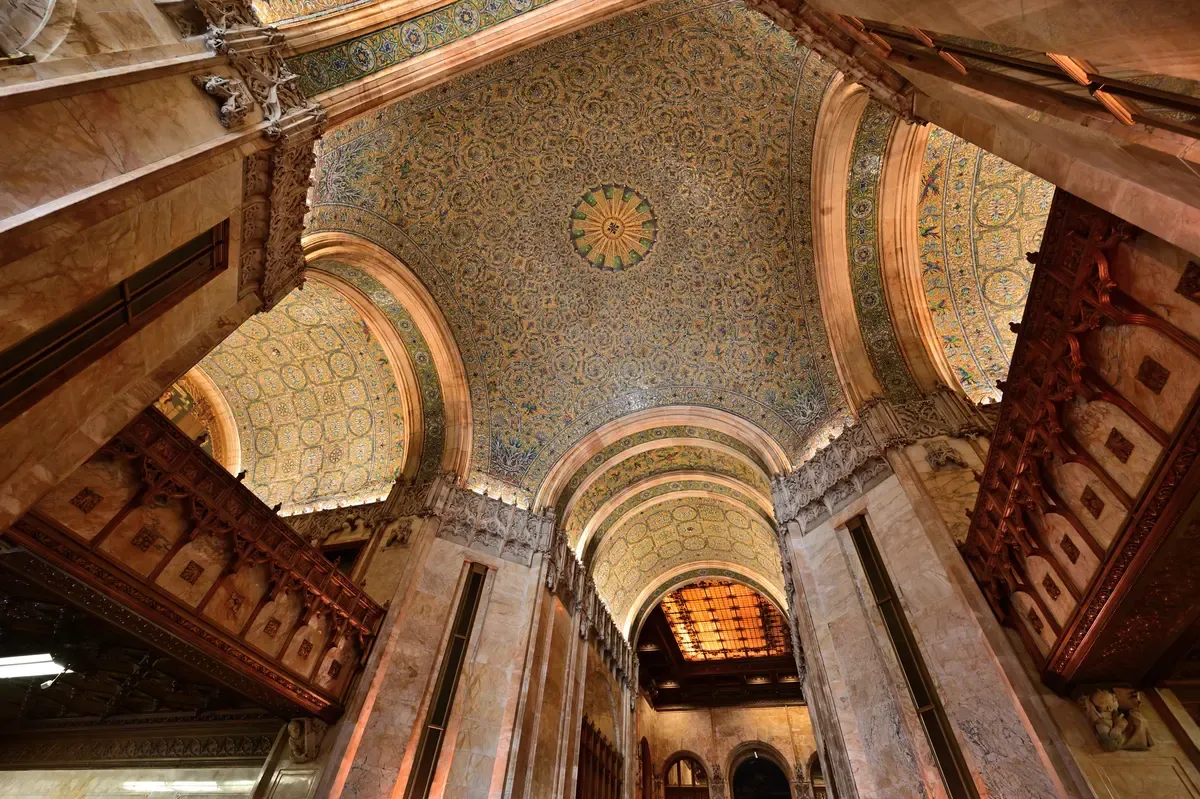
The lobby of the Woolworth Building, built between 1910 and 1913. Photo: Stefan Kemmerling, CC BY-SA 4.0, via Wikimedia Commons
Quick answer Woolworth Building in brief
The Woolworth Building is a 792-foot, 60-story Neo-Gothic skyscraper at 233 Broadway, designed by Cass Gilbert and completed in 1913. Its final construction cost was $13.5 million, and Frank W. Woolworth personally provided $5 million of it. The nickname Cathedral of Commerce comes from its Gothic terracotta dress on a steel office frame. Today the lower floors hold offices and the top 30 floors were converted into 33 luxury apartments.
Key takeaways
- See the exterior and City Hall Park on foot with the SoHo, Little Italy and Chinatown tour, $28 per person.
- View the tower from the water on the AIANY architecture cruise, $86 per person, led by architects.
- Read the design story in Cass Gilbert's Cathedral of Commerce, from the Tudor arch to the Tiffany elevator doors.
- Browse New York architecture tours by district and style to place this tower in a fuller downtown itinerary.
The Woolworth Building in Figures
The numbers behind the tower tell the story faster than any walking route. Every figure below comes from the standard references on the building.
Key Facts at a Glance
The table gathers the core figures for the Woolworth Building in one place, drawn from the published history of the tower. Use it to set expectations before you look for a Woolworth Building tour or a walking route that passes the entrance. The building stands between Broadway, Park Place and Barclay Street, opposite City Hall Park, so almost any downtown walk puts it in frame.
Construction began on November 4, 1910, and the design grew from a planned 420 feet to the final 792 feet as Woolworth chased the height record held by the Metropolitan Life Tower.
| Fact | Figure |
|---|---|
| Address | 233 Broadway, Tribeca, opposite City Hall Park |
| Architect | Cass Gilbert |
| Completed | 1913 |
| Height | 792 feet |
| Stories | 60 counted from the ground, 53 usable floors |
| Final construction cost | $13.5 million ($5 million land, $1 million foundation, $7 million structure) |
| Woolworth's own contribution | $5 million, investors supplied the rest, financing closed by August 1911 |
| Facade | Limestone base, glazed architectural terracotta by the Atlantic Terra Cotta Company |
| Nicknames | The Cathedral of Commerce |
How the Tower Got Its Height
The Woolworth Building rises 792 feet opposite City Hall Park. Its 30-story base under a 30-story tower was engineered so that every office sits within 10 feet of a window, because it was built before air conditioning was common.
The height was not an accident. The design began at 420 feet and grew as Frank W. Woolworth pushed to beat the Metropolitan Life Tower's record. The tower even pioneered its own infrastructure: it was the first structure with its own power plant, four Corliss steam engine generators, and it ran on 26 gearless traction Otis elevators. Woolworth also tied the project to a banking deal, agreeing to vote for the merger of his friend Lewis Pierson's Irving National Bank on condition the bank made the tower its headquarters. If you want to see how this tower fits among downtown's later record chasers, the Oculus NYC guide covers the modern transit hub in Lower Manhattan, and the New York City architecture tour hub lists the districts where each generation of skyscrapers landed.
Sources: NYC Landmarks Preservation Commission, AIA New York tours, New York Public Library tours
Cass Gilbert's Cathedral of Commerce
The Woolworth Building earned its nickname by wrapping a modern steel office frame in Gothic detail on a scale no church ever attempted.
Neo-Gothic Style in Glazed Terracotta
Cass Gilbert dressed the tower in Neo-Gothic form, with pointed arches, pinnacles and a cathedral-like silhouette at the crown. The material choice was practical as much as decorative. The lowest four stories are limestone. Above them the facade is glazed architectural terracotta from the Atlantic Terra Cotta Company, colored in blue, green, sienna and rose, chosen partly because terracotta is fireproof. That mattered for an office tower.
The Broadway entrance is the set piece. It is a three-story Tudor arch whose intrados holds 23 niches of animated figures, including likenesses of the people behind the project. Look up as you cross Broadway from City Hall Park. Many visitors photograph the tower from the park side, where the full 792-foot shaft reads in one frame. Two bookable walks put you exactly there: the SoHo, Little Italy and Chinatown tour at $28 per person starts at City Hall and passes the building in its first stretch, and for the wider skyline view, the AIANY architecture cruise at $86 per person circles Manhattan past the tower with architects from the AIA New York Chapter narrating. You can also read the guide to the Brooklyn Bridge tour for the crossing that frames the tower from the east.
The Lobby: Marble, Mosaic and Tiffany
The cruciform lobby arcade is the richest interior detail in the building. It is covered in veined marble from Skyros in Greece, and its ceilings are glass mosaic in blue, green and gold with red accents. C. Paul Jennewein painted the lobby ceiling murals, titled Labor and Commerce, and the lobby elevator doors were designed by Tiffany Studios. This is a lobby built to impress a client walking in off Broadway, and it still does.
Access is the honest question every visitor asks. After the 2001 attacks, security restricted access to most of the lobby, and it reopened to public tours in 2014 under a partnership between Cass Gilbert's great-granddaughter Helen Post Curry and Witkoff's vice president Roy A. Suskin, with tours of 30 to 90 minutes offered. The official operator now trades as Woolworth Tours NYC and describes an officially authorized tour with access to the lobby and the vault, booked through FareHarbor. Current access rules, tour lengths on the official site, group sizes and prices could not be confirmed, so none are quoted here. What the catalog on New York architecture tours shows is that no tour in the comparison enters the building, so plan on the exterior plus City Hall Park unless you book the authorized operator directly.
Inside the tower, other details survive from the Woolworth era. Frank W. Woolworth's private office on the 24th floor, in green marble in the French Empire style, is preserved in its original condition. The basement holds an unused bank vault, a restaurant, a barbershop and Woolworth's private marble pool, which was restored in the mid-2010s during the residential conversion. None of these spaces are on any public route, so treat them as background color rather than stops.
The Residences at the Top
The building changed hands twice in recent decades, and both deals shaped what you see today. The Witkoff Group bought it in 1998 after renegotiating the price from $155 million to $137.5 million. On July 31, 2012, an Alchemy Properties-led group bought the top 30 floors for $68 million to convert them into 33 luxury apartments. The penthouse, called The Pinnacle, was listed at $110 million, the highest asking price ever for a downtown Manhattan apartment.
The split building remains in place. Office and commercial tenants occupy the lower floors, and the office portion was refinanced with a $279 million loan from Blackstone. For a visitor this means two things. The upper floors you photograph from the Brooklyn Bridge or from the harbor are private homes, so there is no observation deck to buy into. The historic observation floors are a side note: sources disagree on whether the closed observatory sat on the 55th, 57th or 58th floor, and no open deck is confirmed today. Where the tower meets the skyline from a distance, the water is the best seat, and the AIANY architecture cruise is the only tour in the catalog that guarantees that view with an architect on the microphone.
Tourist in Your Own Town: The Woolworth Building
The New York Landmarks Conservancy on the building and its lobby. Third-party video by NYLandmarks. This site did not shoot it and has no relationship with the creator.
Getting Inside
The Woolworth Building is a working office and residential tower at 233 Broadway, so access is limited and rules have changed over the years. Here is what the record confirms and what it does not.
Lobby Tours
After the 2001 attacks, security restricted access to most of the lobby. It reopened to public tours in 2014, when Woolworth Tours began offering visits of 30 to 90 minutes. That partnership ran between Helen Post Curry, Cass Gilbert's great-granddaughter, and Roy A. Suskin, a vice president at Witkoff. The company now trades as Woolworth Tours NYC and describes an officially authorized tour with access to the lobby and the vault, booked through FareHarbor.
What the record does not settle: the operator's current prices, weekly schedule, group size and exact tour lengths were not confirmed on the official page and are not printed. Current access rules for the lobby outside tour times are also not verified by any primary source. Book directly with the operator and check the day's rules before you travel.
Inside, the tour covers the cruciform lobby arcade, lined in veined marble from Skyros in Greece, with glass mosaic ceilings in blue, green and gold with red accents. The elevator doors were designed by Tiffany Studios, and the ceiling murals Labor and Commerce were painted by C. Paul Jennewein. The Broadway entrance is a three-story Tudor arch whose intrados holds 23 niches of animated figures.
What a Tour Does Not Include
No listing in the catalog claims entry to the upper floors. F. W. Woolworth's private office on the 24th floor, in green marble in the French Empire style, is preserved in original condition, and the basement holds an unused bank vault, a restaurant, a barbershop and Woolworth's private marble pool, restored in the mid-2010s during the residential conversion. None of these spaces is confirmed as part of any walk you can book here.
The top 30 floors became 33 luxury apartments after an Alchemy Properties-led group bought them for $68 million, and the penthouse, The Pinnacle, was listed at $110 million, the highest asking price ever for a downtown Manhattan apartment. Residents' floors are private.
Walking Past the Exterior
You do not need a ticket to see the best of the building. The glazed architectural terracotta from the Atlantic Terra Cotta Company, in blue, green, sienna and rose, runs the full 792 feet of facade above the four limestone ground stories. City Hall Park opposite gives you the classic full-height view of the tower.
Two catalog walks pass it from outside. The first is the SoHo, Little Italy and Chinatown Guided Tour, a 2 hour walk for $28 per person that starts at the intersection of Warren Street and Broadway, in front of City Hall Subway Station, and passes the Woolworth Building, City Hall Park and St. Paul's Chapel before crossing into Chinatown. The second is waterborne: the Manhattan Official NYC Architecture Cruise costs $86 per person, runs 2 hours to 2 hours 45 minutes and circles the island past the Woolworth Building with architects from the AIA New York Chapter as hosts.
Both are cataloged on the page of New York architecture tours.
| Walk | Price | Duration | How You See the Building |
|---|---|---|---|
| SoHo, Little Italy and Chinatown Guided Tour | $28 per person | 2 hours | Exterior, from City Hall Park |
| Manhattan Official NYC Architecture Cruise | $86 per person | 2 to 2 hours 45 minutes | Exterior, from the water |
Getting There
The building stands between Broadway, Park Place and Barclay Street, opposite City Hall Park at 233 Broadway in Tribeca. Two basement entrances once linked it directly to the Park Place and City Hall subway stations. The Park Place entrance has been closed since 2001 and the City Hall entrance since 1982, so there is no through connection today.
Street access on Broadway or Park Place is the way in.
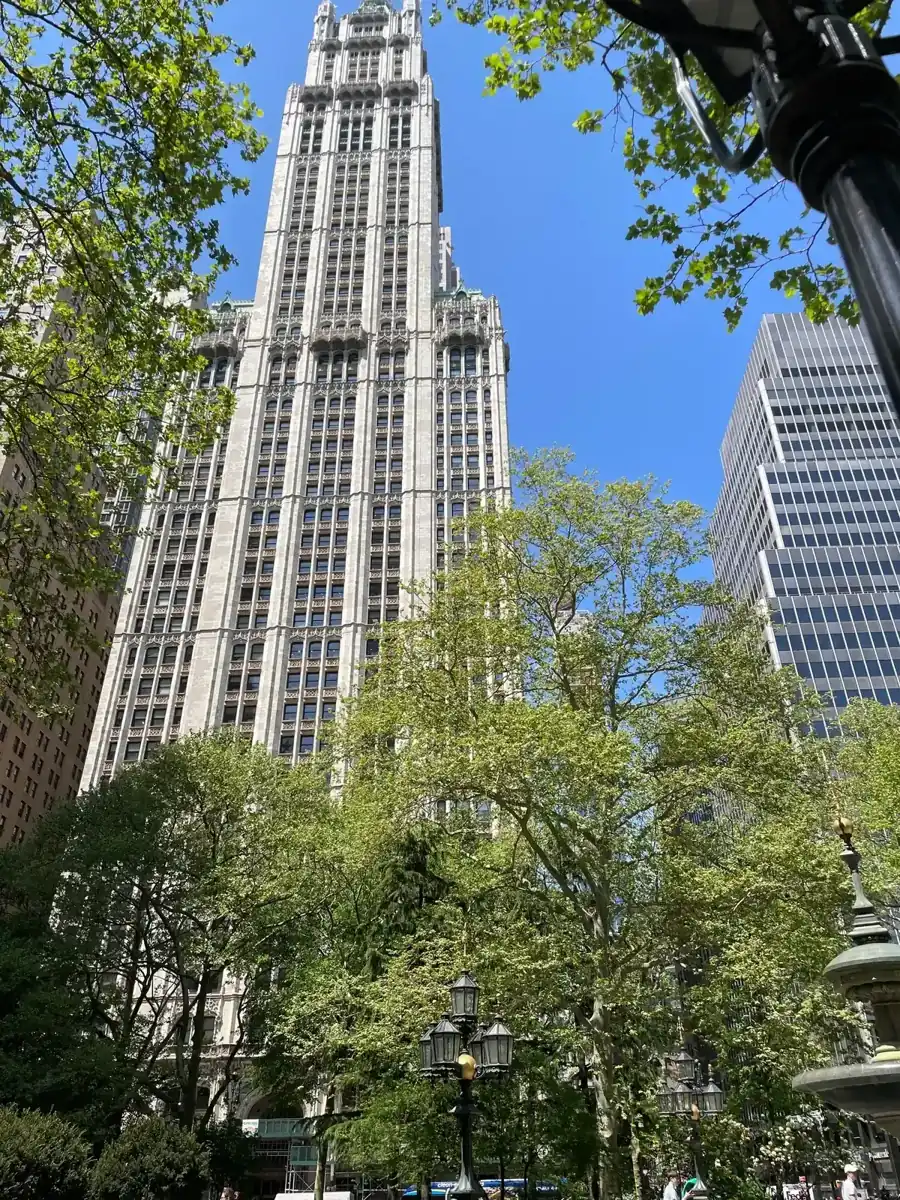
The Woolworth Building seen from City Hall Park in May 2024. Photo: Deans Charbal, CC BY-SA 4.0, via Wikimedia Commons
City Hall Park and Its Neighbours
The tower's front garden is City Hall Park, and a short loop from its door covers some of the most important architecture in Lower Manhattan.
City Hall Park
The Woolworth Building stands opposite City Hall Park, and the park side is where the tower reads best: you get the full 792-foot Gothic silhouette without craning your neck. The SoHo, Little Italy and Chinatown Guided Tour begins at City Hall Subway Station on the park's edge and uses the Woolworth Building and St. Paul's Chapel as early stops. For the wider downtown picture, including the transit hub that anchors the west side of the district, see the guide to the Oculus NYC.
Federal Hall
The current Federal Hall at 26 Wall Street was completed in 1842 in the Greek Revival style by Ithiel Town, Alexander Jackson Davis and John Frazee. George Washington took the presidential oath here on April 30, 1789 at the earlier building, and the Bill of Rights was proposed on September 25, 1789. Today it is a National Memorial run by the National Park Service with free admission, offering self-guided exhibits of about 30 minutes and ranger-guided tours of one to two hours.
It has a 60-foot-diameter rotunda and a Washington statue by John Quincy Adams Ward, erected in 1883. When the interior is closed, the exterior and the statue can still be viewed.
The New York Stock Exchange Building
The NYSE at 18 Broad Street was designed by George B. Post and opened April 23, 1903. Its facade is white Georgia marble with six fluted columns, each 52 feet tall, and the pediment sculpture of eleven figures led by Integrity was designed by John Quincy Adams Ward and Paul Wayland Bartlett. It is a National Historic Landmark and an NYC landmark, but it is closed to general public tours.
The Wall Street Insider Tour covers the district for $39 per person in 1 hour 15 minutes led by former traders and bankers, with the entrance to the exchange explicitly not included.
Trinity Church and 40 Wall Street
Trinity Church at 89 Broadway at Wall Street was designed by Richard Upjohn in the Gothic Revival style and consecrated May 1, 1846. Its 281-foot spire was the tallest in New York City until 1890, and Alexander Hamilton and Robert Fulton are buried in its churchyard. 40 Wall Street was designed by H. Craig Severance with Yasuo Matsui and completed May 1, 1930. Its own article gives 927 feet and 70 stories, while the Chrysler Building article puts it at 840 feet when the Chrysler passed it.
It briefly held the world's tallest title for about a month before the Chrysler Building passed it. The Wall Street Historic District was listed on the National Register on February 20, 2007 and covers 63 acres, and its street plan follows medieval patterns rather than Manhattan's grid.
Do and Don't
Do
- Do book the authorized lobby tour in advance through the operator's FareHarbor page, because the lobby reopened to public tours only in 2014 and access outside tour times is not something the record confirms.
- Do start from City Hall Park, because the park opposite 233 Broadway is the vantage point where the full 792-foot tower and its blue, green, sienna and rose terracotta read best.
- Do look up at the Broadway entrance arch, because the three-story Tudor arch holds 23 niches of animated figures, detail you miss at street pace.
- Do combine the building with the Brooklyn Bridge and the Financial District, because Federal Hall has free admission and Trinity Church holds Hamilton's grave.
- Do consider the architect-narrated cruise as an alternative view, because the $86 per person Manhattan Official NYC Architecture Cruise passes the tower from the harbor with AIA New York Chapter architects aboard.
Don't
- Don't expect to enter the upper floors on any catalog tour, because the top 30 floors are 33 private apartments and no listing here includes residential access.
- Don't look for the old subway entrances, because the basement doors to Park Place and City Hall stations closed in 2001 and 1982 and there is no through connection today.
- Don't trust the story that Frank Woolworth paid the whole bill in cash, because the record shows he provided $5 million of the $13.5 million cost and investors supplied the rest.
- Don't plan your day around an observation deck, because the building's former observatory figures conflict between sources and no open deck is confirmed today.
Woolworth Building FAQ
Can you visit the Woolworth Building?
Partly. Public lobby tours returned in 2014 with visits of 30 to 90 minutes, and the authorized operator today describes access to the lobby and the vault booked through FareHarbor. Current access rules outside tour times are not verified by any primary source. The free way in is the street: see the access section above or start with the page of New York New York architecture tours.
Why is the Woolworth Building famous?
It was the tallest thing of its moment at 792 feet, finished in a Neo-Gothic terracotta skin that earned it the name the Cathedral of Commerce. Cass Gilbert designed it for Frank W. Woolworth, and the full story is in the sections above.
Is the Woolworth Building still standing in New York?
Yes. It stands at 233 Broadway in Tribeca, between Broadway, Park Place and Barclay Street opposite City Hall Park. The office portion was refinanced with a $279 million loan from Blackstone, and it remains a fixture of any New York architecture tours of downtown.
Which tours pass the Woolworth Building?
Two in the catalog. The $28 per person SoHo, Little Italy and Chinatown Guided Tour walks past it from City Hall Park, and the $86 per person Manhattan Official NYC Architecture Cruise passes it from the water with architects from the AIA New York Chapter narrating.
Are there apartments in the Woolworth Building?
Yes. An Alchemy Properties-led group bought the top 30 floors for $68 million and converted them into 33 luxury apartments. The penthouse, The Pinnacle, was listed at $110 million, the highest asking price ever for a downtown Manhattan apartment. The lower floors remain offices, so tours stay in the lobby, as covered in the getting-inside section above.
How do I get to the Woolworth Building by subway?
Walk to it from the street: the building's own basement entrances to the Park Place and City Hall stations are closed, the Park Place one since 2001 and the City Hall one since 1982. Once you are there, the neighboring sights in the City Hall Park section above are all on foot.