 New York Architecture Tour
Rockefeller Center Tour: The Complex, the Art and How to See It
A Rockefeller Center tour is a way into the 22-acre Art Deco complex in Midtown, which holds 19 structures, 14 of them original Art Deco buildings raised in the 1930s under Raymond Hood and three associated firms. This page looks at the center as an architecture visit: the buildings, the sculpture, the observation deck at 30 Rockefeller Plaza and the guided walks that list it. For a broader comparison of New York architecture tours across every district, see the architecture tour New York City.
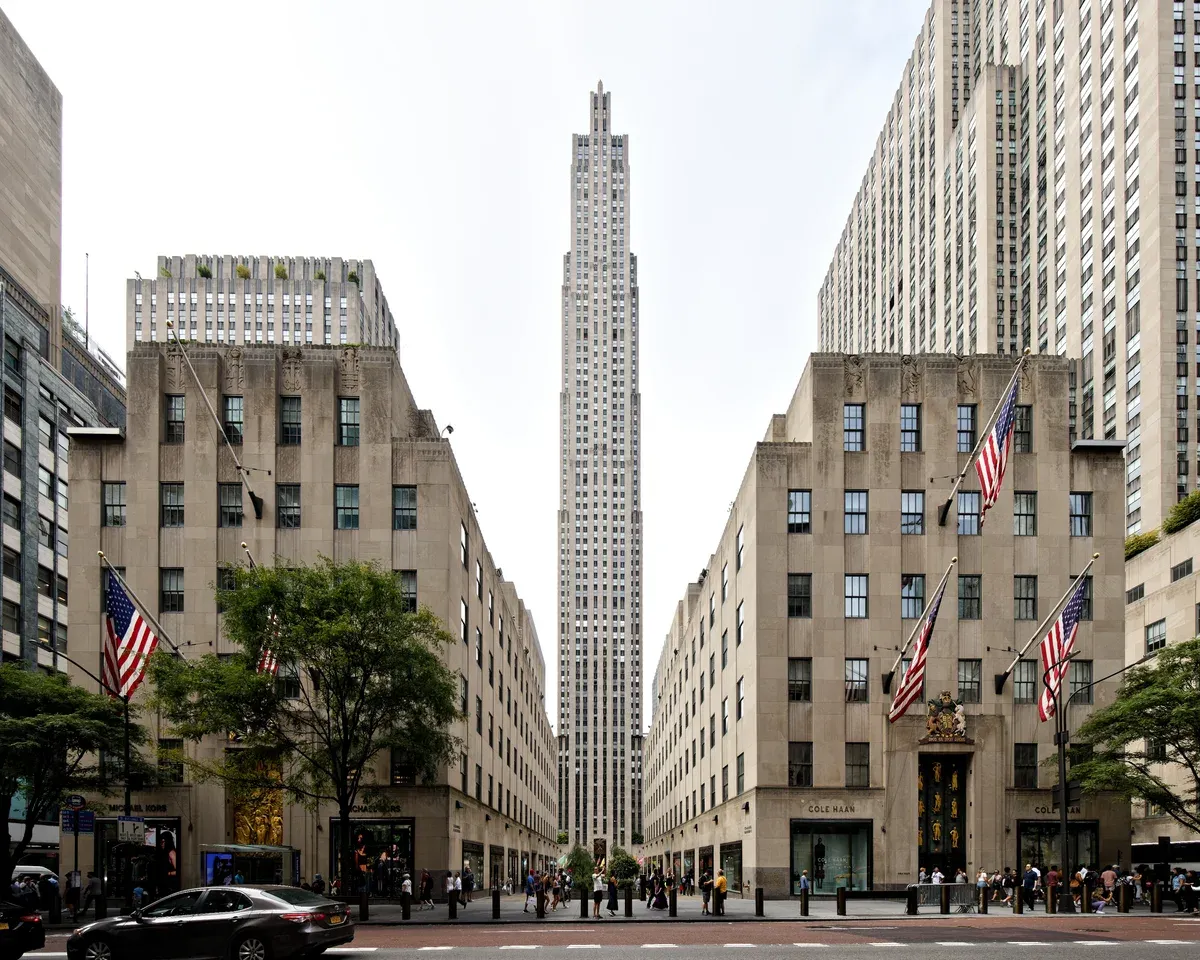
30 Rockefeller Plaza viewed from Fifth Avenue. Photo: D. Benjamin Miller, CC0, via Wikimedia Commons
Quick answer Rockefeller Center in brief
Rockefeller Center spans 22 acres between Fifth and Sixth Avenues from 48th to 51st Streets, with 19 structures today. A Rockefeller Center tour can mean the paid Art Deco and Architecture Midtown Landmarks Tour at $40 per person, which ends at the complex, or a do-it-yourself visit through the plazas and lobbies. The centerpiece, 30 Rockefeller Plaza, is an Art Deco tower completed in 1933, put at 850 feet by its own article and 872 feet by the complex article, with the Top of the Rock deck on its upper floors. The sculpture alone justifies the walk: Prometheus, Atlas and Lee Lawrie's Wisdom are all here.
Key takeaways
- Book the $40 Art Deco Midtown walk to see Rockefeller Center with a guide as the last stop of a 2 hour 30 minute route that starts at 1095 6th Avenue.
- Learn the buildings and sculpture first in The Complex, Building by Building and The Art Deco Art.
- Compare it with the nearby Official Grand Central Tour at $39, a 1.5 hour interior walk.
- Browse every option on one page of New York architecture tours sorted by district and style.
The Complex, Building by Building
Rockefeller Center is not one building but a planned city block group, and its scale is the point of any visit.
Key Buildings and Works at a Glance
The table below pulls the core figures for the buildings and artworks a Rockefeller Center visit covers. Dates, names and dimensions come from the facts recorded for each structure and work. Note that sources disagree on one headline number: the Rockefeller Center article describes 30 Rockefeller Plaza as 872 feet and 70 stories, while its own building article gives 850 feet and 66 stories, and adds that Top of the Rock occupies floors 67 to 69, so the tower has at least 69 numbered floors. The table gives both counts.
Use the table as a checklist. The buildings and sculptures in it can all be seen from the street without a ticket.
| Building or work | Year | Architect or artist | Detail |
|---|---|---|---|
| 30 Rockefeller Plaza (Comcast Building) | Completed 1933 | Associated Architects, principal Raymond Hood | Art Deco tower, 850 feet and 66 stories by the building's own article, 872 feet and 70 stories by the complex article, about 6,000 windows, NBC headquarters |
| Radio City Music Hall | Opened December 27, 1932 | Exterior Edward Durell Stone, interiors Donald Deskey | About 6,000 seats (5,960 in the hall's own article) at 1260 Avenue of the Americas, home of the Rockettes |
| Prometheus | 1934 | Paul Manship | Gilded bronze, 18 feet tall, 8 tons, lower plaza of 30 Rockefeller Plaza |
| Atlas | Installed 1937 | Lee Lawrie and Rene Chambellan | 45 feet overall, 15-foot figure, 14,000 pounds, International Building courtyard |
| Wisdom, A Voice from the Clouds | Completed 1933 | Lee Lawrie | Crowns the 37-foot, 14-foot-wide entrance arch of 30 Rockefeller Plaza |
| Lower Plaza ice rink | Opened 1936, permanent rink 1939 | not stated | Permanent rink measures 120 feet across |
| Rockefeller Plaza (private street) | Built 1933-1937 | Associated Architects | Splits the 14 original buildings, runs to the sunken Lower Plaza |
| Celanese Building | 1974 | not stated | Last building added to the complex |
The Plan and the Channel Gardens
John D. Rockefeller Jr. leased the site from Columbia University in 1928 for 87 years at $3 million a year, and Columbia owned the land until 1985. The project was first meant to house a new Metropolitan Opera building, and the plan changed when the Met could not afford the move. The initial cost of land, demolition and construction was estimated at $250 million.
Rockefeller hired three firms working together as the Associated Architects: Corbett, Harrison & MacMurray, Hood, Godley & Fouilhoux, and Reinhard & Hofmeister. No building could be credited to one firm. Raymond Hood was the principal architect, and he had already proven the style at the American Radiator Building on West 40th Street, a 1924 black-brick tower with gold ornament.
Construction started in the early 1930s, the first buildings opened in 1933 and the core was finished by 1939. The 14 original buildings divide into the International Complex on Fifth Avenue, built for foreign-based tenants, and the Radio City group on Sixth Avenue centered on 30 Rockefeller Plaza. A promenade named the Channel Gardens was planned from Fifth Avenue down to the plaza, and a 2020 renovation by Gabellini Sheppard Associates redid the Channel Gardens, Rockefeller Plaza and the Lower Plaza.
The complex was an immediate draw. By fall 1939 it held 26,000 tenants and 125,000 daily visitors, and 1.3 million people took a guided tour or visited the RCA Building's observation deck that year. Tishman Speyer bought the buildings and land in December 2000 for $1.85 billion. The center became an NYC landmark in April 1985 and a National Historic Landmark in December 1987.
Today the story continues above the plaza. The old observation deck closed in 1986 when the Rainbow Room renovation cut off its only access, and it reopened in 2005 as Top of the Rock on floors 67 to 69, entered from 50th Street high up the tower. Across Fifth Avenue, St. Patrick's Cathedral and its 329.5-foot spires give the complex its best known backdrop, and the cathedral has its own visit guide. If you want a guided route that ends here, the Art Deco Midtown walk covers the center as its final stop.
The Art Deco Art
Rockefeller Center holds a large body of public Art Deco sculpture, and all of it is free to see from the street.
Prometheus and the Lower Plaza
Paul Manship's gilded bronze Prometheus dates from 1934 and stands in the Lower Plaza directly in front of 30 Rockefeller Plaza. It is 18 feet tall and weighs 8 tons, and the rim carries a paraphrase of a line from Aeschylus. In winter the sculpture rises over the ice rink, which opened in 1936 as a temporary measure and got its permanent 120-foot rink in 1939. The Christmas tree tradition here began in December 1933, one year after Radio City opened.
The lobby of 30 Rockefeller Plaza is also where the center's most famous art controversy played out. In 1932 Nelson Rockefeller commissioned Diego Rivera to paint a color fresco on a 1,071-square-foot lobby wall of 30 Rockefeller Plaza. The unfinished Man at the Crossroads was destroyed in 1934. Nothing of it survives on site.
Atlas on Fifth Avenue
Lee Lawrie and Rene Chambellan's Atlas was installed in 1937 in the courtyard of the International Building on Fifth Avenue, facing east toward St. Patrick's Cathedral. The whole piece stands 45 feet tall, though the figure itself is 15 feet, and it weighs 14,000 pounds. Instead of a solid globe, Atlas carries an armillary sphere.
The statue faces east toward the cathedral across Fifth Avenue.
Wisdom and Lee Lawrie's Twelve Pieces
Lee Lawrie contributed twelve pieces to Rockefeller Center, more than any other sculptor. The most prominent is Wisdom, A Voice from the Clouds, the relief crowning the center entrance arch of 30 Rockefeller Plaza, flanked by Sound on the left and Light on the right. The arch itself measures 37 feet high and 14 feet wide, set into the limestone facade above the plaza entrance.
The facade is worth studying on its own: limestone over a granite base, with about 6,000 windows divided by aluminum spandrels, the vertical striping that defines the building. 30 Rockefeller Plaza was renamed for Comcast in July 2015 and carries the nicknames 30 Rock and, earlier, the RCA and GE Building. The Today show studios and NBC News are inside.
Across the complex, Radio City Music Hall adds Donald Deskey's interiors to the list, and the hall's interior became an NYC landmark in 1978 with the exterior following in 1985. A separate page covers the Chrysler Building, the other great Art Deco tower of the era, and the free interior visits at the library are covered in the New York Public Library tour guide.
Rockefeller Center Explored and Explained
A walk through the complex with the art and buildings explained. Third-party video by Architectural Digest. This site did not shoot it and has no relationship with the creator.
Ways to See It
There is more than one way to take in 22 acres of Art Deco. Some cost nothing, some are guided, and one takes you up to a deck high above the street.
The Official Rockefeller Center Tour
The Rockefeller Center website is the place to look for any official guided tour of the complex. Its length, group size and price could not be confirmed for this guide, so none are stated here. Check the official site for current times and tickets.
If you want a guided look that also puts Rockefeller Center in the wider context of Midtown's Deco decade, the paid walk below covers it alongside other landmarks.
The Free Plaza
Walking the complex on your own costs nothing. The 14 original buildings sit between Fifth and Sixth Avenues from 48th to 51st Streets, split by the sunken Lower Plaza and the private street Rockefeller Plaza, which was built in stages between 1933 and 1937. The Channel Gardens promenade runs from Fifth Avenue toward the plaza.
Prometheus stands in the Lower Plaza and Lee Lawrie's Atlas faces Fifth Avenue from the International Building courtyard. All of it is outdoors and open to anyone passing through. In winter the plaza fills with an ice rink that first opened in 1936 as a temporary measure and became a permanent 120-foot rink in 1939, plus the Christmas tree tradition that started in December 1933.
For background on what you are looking at, see the sections above or browse the other New York architecture tours.
A Guided Midtown Walk That Includes Rockefeller Center
The Art Deco and Architecture Midtown Landmarks Tour by Custom NYC Tours is a 2 hour 30 minute walk for $40 per person, capped at 10 guests. It starts in front of Whole Foods at 1095 6th Avenue and passes Bryant Park, the New York Public Library, the American Radiator Building, the Chanin Building, Grand Central Terminal and Rockefeller Center, with several indoor stops. Full details are on the Art Deco Midtown walk page.
| Option | Cost | Length | What it covers |
|---|---|---|---|
| Official Rockefeller Center tour | See official site | not stated | The complex's art and architecture |
| Free self-guided walk | Free | Your own pace | Plazas, Prometheus, Atlas, facades |
| Art Deco Midtown Landmarks Tour | $40 per person | 2 hours 30 minutes | Rockefeller Center plus eight other named Midtown stops |
Radio City Music Hall
At 1260 Avenue of the Americas on the Sixth Avenue side of the complex stands Radio City Music Hall, opened December 27, 1932 with an exterior by Edward Durell Stone and interiors by Donald Deskey. It seats 5,960 and is the home of the Rockettes. The interior became an NYC landmark in 1978 and the exterior followed in 1985.
Any tour of the hall itself is not covered here, so check the hall's own site before you go.
Top of the Rock
The observation deck on floors 67 to 69 of 30 Rockefeller Plaza reopened in 2005 after the original deck closed in 1986. Entry is from 50th Street, with two elevators to the 67th floor and escalators up to the 69th. The deck sits behind an 8.5-foot frameless glass parapet designed by Gabellini Sheppard Associates.
Ticket prices are sold on the official site and are not printed here.
Sources: Rockefeller Center, Radio City Music Hall, 30 Rockefeller Plaza
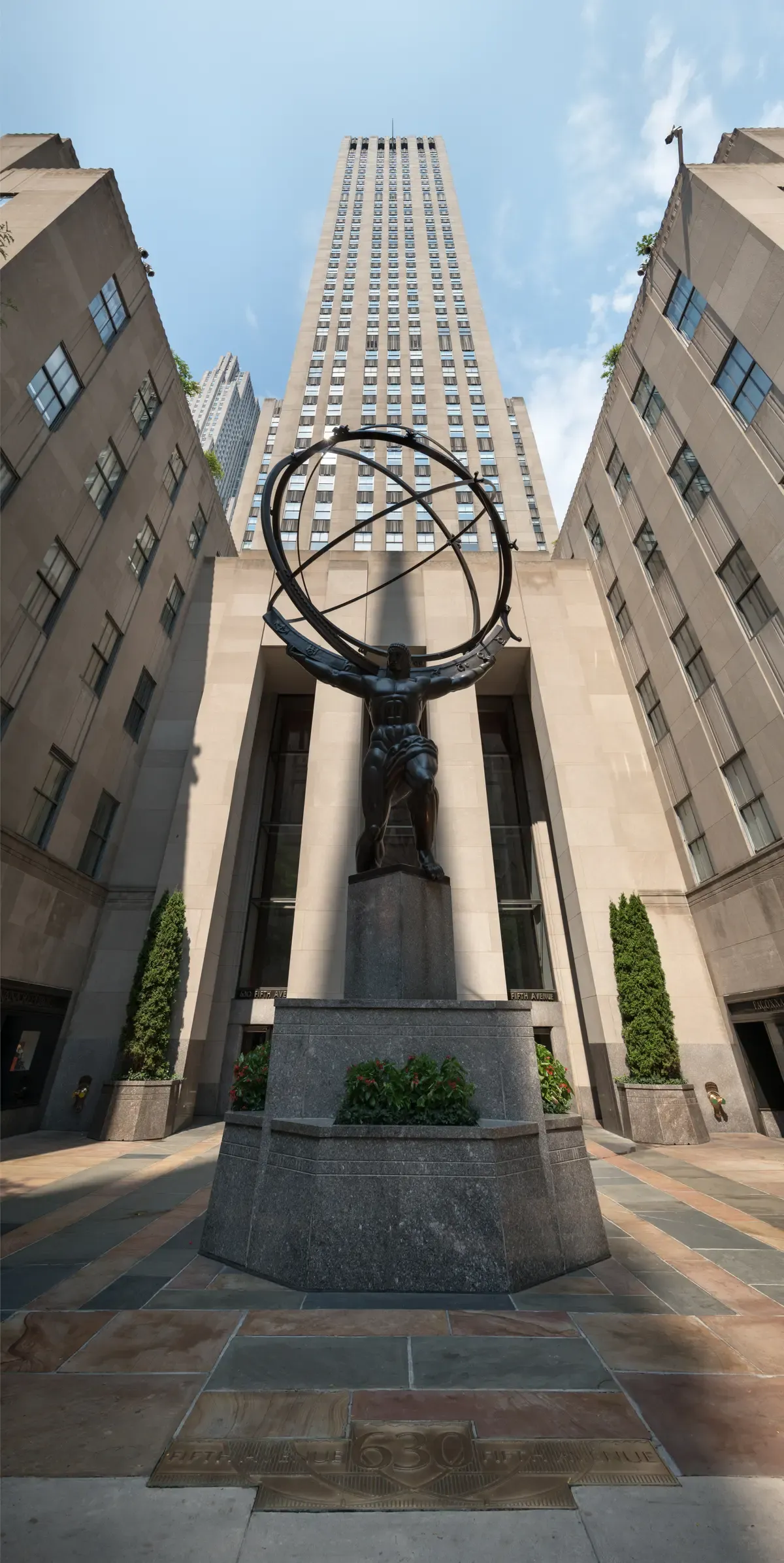
The Atlas statue by Lee Lawrie in the forecourt of Rockefeller Center. Photo: Giorgio Galeotti, CC BY 4.0, via Wikimedia Commons
How Rockefeller Center Was Built
The project began with an opera house that never arrived and finished as the defining Art Deco complex in America.
A Lease, an Opera House and a Change of Plan
Columbia University owned the site until 1985 and in 1928 leased it to John D. Rockefeller Jr. for 87 years at $3 million a year. The first idea was a new home for the Metropolitan Opera, but the Met could not afford the move and the plan changed. Land, demolition and construction were estimated at $250 million, and the lease ran on regardless of the change of plan.
Raymond Hood and the Associated Architects
Rockefeller hired three firms working together as Associated Architects, so no single building could be credited to one office: Corbett, Harrison & MacMurray, Hood, Godley & Fouilhoux, and Reinhard & Hofmeister. The principal architect was Raymond Hood, who had already made his name with the American Radiator Building at 40 West 40th Street, a 338-foot black brick and gold tower completed in 1924. Lee Lawrie contributed twelve sculptural pieces to the complex, more than any other sculptor, including the Wisdom relief over the entrance of 30 Rockefeller Plaza.
Building Through the Depression
Construction started in the early 1930s, the first buildings opened in 1933, and the core of the complex was finished by 1939. The 30 Rockefeller Plaza tower itself was completed in 1933. By fall 1939 the complex had 26,000 tenants and 125,000 daily visitors, and 1.3 million people took a guided tour or visited the RCA Building's observation deck that year.
Rockefeller Center was made an NYC landmark in 1985 and a National Historic Landmark in 1987. Tishman Speyer bought the buildings and land in December 2000 for $1.85 billion.
The Mural That Was Destroyed
In 1932 Nelson Rockefeller commissioned Diego Rivera to paint a fresco on a 1,071-square-foot lobby wall of 30 Rockefeller Plaza. The unfinished Man at the Crossroads was destroyed in 1934. Later growth took longer: the last building of the expanded complex, the Celanese building, went up in 1974, and in 2020 Tishman Speyer hired Gabellini Sheppard Associates to renovate the Channel Gardens, Rockefeller Plaza and the Lower Plaza.
Sources: Rockefeller Center, American Radiator Building
Tips for Your Visit
Nine things worth knowing before you set out, all drawn from the facts above.
Do
- Do start at Fifth Avenue and 49th or 50th Street, because the Channel Gardens run from Fifth Avenue straight down to the Lower Plaza and give you the classic first view of 30 Rockefeller Plaza.
- Do look up at the entrance arch of 30 Rockefeller Plaza, because Lee Lawrie's Wisdom relief crowns an arch 37 feet high and 14 feet wide, flanked by Sound and Light.
- Do pair the center with St. Patrick's Cathedral across the street, because the Atlas statue was deliberately placed facing east toward the cathedral's spires at 631 Fifth Avenue.
- Do book the Art Deco Midtown walk if you want context, because at $40 per person in groups of up to 10 it ends at Rockefeller Center after eight other named Midtown stops.
- Do come in winter if you want the rink and the tree, because the rink has been on the Lower Plaza since 1936 and the tree tradition started in December 1933.
Don't
- Don't assume the walk goes up the tower, because the observation deck is entered from 50th Street and the tour listing names only the complex as a stop.
- Don't hunt for Rivera's mural, because the unfinished fresco was destroyed in 1934.
- Don't credit one firm with the design, because three offices worked as Associated Architects and no single building was credited to one firm.
- Don't plan the visit around the Chrysler Building on the same block, because it stands at 405 Lexington Avenue, off the Rockefeller block, and deserves its own trip, covered in the Chrysler Building guide.
Frequently Asked Questions
Can you go up Rockefeller Center?
Yes. The Top of the Rock deck on floors 67 to 69 of 30 Rockefeller Plaza reopened in 2005 and is entered from 50th Street. Visitors ride two elevators to the 67th floor, then escalators to the 69th. Tickets are sold on the official site.
Is there an official Rockefeller Center tour?
The details of any official Rockefeller Center tour could not be confirmed for this guide, so check the official site for current times and tickets. This guide covers what you will see on the plaza.
Can you see Rockefeller Center for free?
The outdoor complex is free to walk. The 14 original buildings stand between Fifth and Sixth Avenues from 48th to 51st Streets, with Prometheus in the Lower Plaza and Atlas in the International Building courtyard. For a narrated version, the Art Deco and Architecture Midtown Landmarks Tour costs $40 per person.
What is the tall building at Rockefeller Center?
It is 30 Rockefeller Plaza, officially the Comcast Building and formerly the RCA and GE Building, nicknamed 30 Rock. The Art Deco tower, 850 feet and 66 stories by its own article and 872 feet and 70 stories by the complex article, was completed in 1933 with a limestone facade over a granite base and about 6,000 windows. It is NBC's headquarters, and it anchors the Midtown Art Deco walk.
Who designed Rockefeller Center?
Raymond Hood was the principal architect, working with three firms hired as Associated Architects: Corbett, Harrison & MacMurray, Hood, Godley & Fouilhoux, and Reinhard & Hofmeister. Hood also designed the black and gold American Radiator Building on West 40th Street, which is a stop on the Art Deco Midtown tour.
Is Rockefeller Center worth visiting outside the holiday season?
Yes, because the Art Deco architecture and sculpture are there all year. Lee Lawrie's twelve sculptural pieces, the 37-foot entrance arch and the two famous statues need no seasonal dressing, and the complex became a National Historic Landmark in 1987. A broader list of famous buildings in NYC helps you plan the rest of the day.