 New York Architecture Tour
The Chrysler Building: Height, History and Visiting
The Chrysler Building at 405 Lexington Avenue is an Art Deco tower in Midtown Manhattan, and this guide covers its figures, its famous race to be the world's tallest, and the stainless steel crown that made it famous. You can walk into the lobby, which is the only publicly accessible part of the building, and you can see the crown from several street corners nearby. The guided walks that pass it, including the Art Deco Midtown walk, are compared on all New York architecture tours.
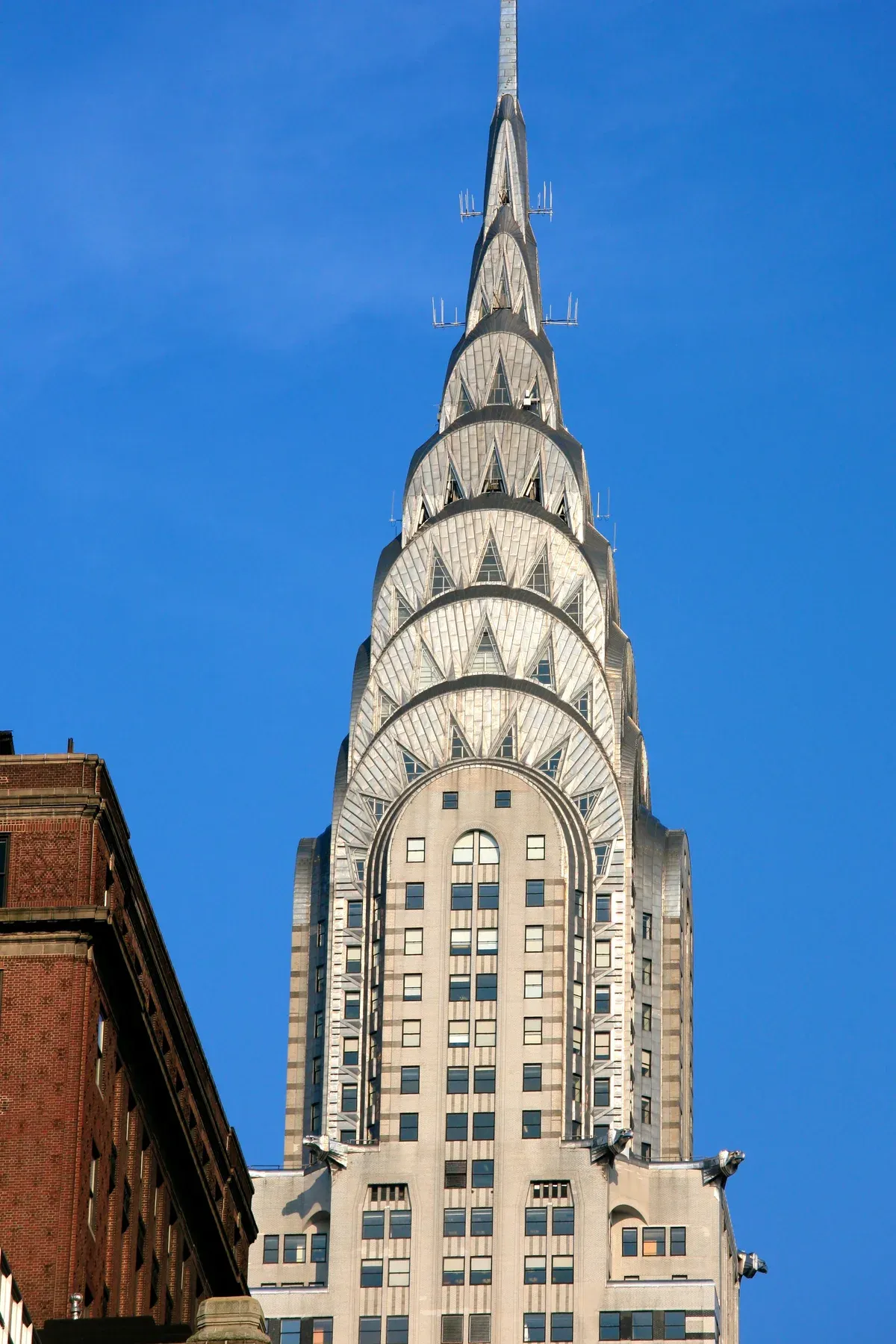
The crown of the Chrysler Building, with its tiers of arches and the spire above. Photo: Alex Proimos from Sydney, Australia, CC BY 2.0, via Wikimedia Commons
Quick answer Chrysler Building at a glance
The Chrysler Building stands 1,046 feet to the tip of its spire and 925 feet to the roof, with 77 floors at 405 Lexington Avenue. William Van Alen designed it in the Art Deco style and it opened on May 27, 1930. Only the triangular lobby is publicly accessible. The building held the world's tallest record for about 11 months before the Empire State Building passed it.
Key takeaways
- The Chrysler Building in Figures table collects the height, floor count, dates, architect and client from the record.
- The race for the tallest building explains the secret 125-foot spire that beat 40 Wall Street and was raised into place in 90 minutes.
- The crown, spire and ornaments section covers the Nirosta steel arches and the eagle heads at the 61st floor.
- The Art Deco Midtown walk, a $40 per person guided tour, passes the Chrysler Building on a 2 hour 30 minute route.
The Chrysler Building in Figures
These are the headline numbers for the tower at 405 Lexington Avenue, drawn from the public record on the building's construction and design.
Key Figures
The table below pulls together the core facts about the Chrysler Building: how tall it is, how many floors it has, when it was built, who designed it and who put up the money. Walter Chrysler bought the plot, the lease and Van Alen's plans from developer William H. Reynolds on October 15, 1928 for more than $2.5 million. Construction started on January 21, 1929 and the building opened on May 27, 1930.
The land itself belongs to The Cooper Union, which received it in 1902, and the building's owners lease it.
| Fact | Figure | Source detail |
|---|---|---|
| Height | 1,046 feet to spire tip, 925 feet to roof | 77 floors |
| Architect | William Van Alen | Art Deco style |
| Client | Walter Chrysler | Bought plot, lease and plans for more than $2.5 million |
| Construction start | January 21, 1929 | Plot bought October 15, 1928 |
| Opening | May 27, 1930 | 405 Lexington Avenue |
The Race for the Tallest Building
Construction turned into a three-way race with 40 Wall Street and the Empire State Building to be the world's tallest. In April 1929 architect H. Craig Severance, Van Alen's former partner, raised 40 Wall Street to 840 feet and 62 floors, 32 feet above the Chrysler's planned height. Van Alen answered with a trick. He obtained permission for a 125-foot spire and had it secretly assembled inside the building frame, so Severance did not learn the final height until the end.
On October 23, 1929, one day before the Wall Street Crash, the spire was hoisted into place in 90 minutes, with the bottom section lowered into the 66th floor. The lift took the Chrysler Building past the Eiffel Tower, making it the first man-made structure above 1,000 feet and the first supertall skyscraper. It held the world's tallest title from May 27, 1930 to May 1, 1931, about 11 months, until the Empire State Building opened. That building, designed by Shreve, Lamb and Harmon, reaches 1,250 feet to the roof and 1,454 feet with its antenna across 102 stories. If you want the terminal covered properly, the separate Grand Central Terminal tour page owns that subject.
A note on 40 Wall Street: the Chrysler Building article records it at 840 feet when the spire won the race, while the 40 Wall Street article gives the finished building 927 feet and 70 floors. Both figures appear in the sources and they are not reconciled.
- Van Alen sued Walter Chrysler over his unpaid fee after the opening and won $840,000, six percent of the building's budget.
- The Chrysler family sold the building in 1953 for $18 million.
- Tishman Speyer and Travelers paid about $220 million for it in November 1997, and the 1998-2000 renovation of the Chrysler Center cost about $100 million.
The Building as Structure
The Chrysler Building is the tallest steel-framed brick building in the world, with a steel frame and masonry infill behind 3,862 exterior windows. Its 32 elevators run in four banks and were designed to travel at 900 feet per minute at a time when city rules capped elevator speed at 700. Each cab carries a unique combination of woods in marquetry.
The building earned its protections quickly by New York standards. It became a National Historic Landmark on December 8, 1976 and a New York City landmark for both facade and lobby on September 12, 1978. A 2020 plan approved by the Landmarks Preservation Commission would add an observation deck on the 61st-story setback, but nothing confirms it was built, so treat any claim of a public deck as unproven.
Sources: Chrysler Building, Empire State Building
The Crown, the Spire and the Ornaments
The top of the building is the reason most people stop on Lexington Avenue, and every element of it carries a story from the construction years.
The Stainless Steel Crown
The crown is seven radiating terraced arches clad in Nirosta stainless steel, laid out in a sunburst pattern with triangular windows. Nirosta contains 18 percent chromium and 8 percent nickel, and using it on the spire and crown was a first for an American project. Since 1981, tube lights have framed 120 window openings around the arches.
The same steel covers the 125-foot spire that was raised into place in 90 minutes on October 23, 1929.
Eagles, Hood Ornaments and the Chrysler Details
The building is dressed as a Chrysler product. The 31st-floor corners carry large car-hood ornaments and replicas of the 1929 Chrysler radiator caps. At the 61st floor there are eagle-head figures. Photographer Margaret Bourke-White climbed a scaffold 400 feet up in December 1929 to shoot the eagle figures.
The Cloud Club, a private dining club, occupied floors 66 to 68 and opened in July 1930 with about 300 members. It closed in 1979 after Texaco left the building.
The Lobby and What You Can Actually Enter
The lobby is the one part of the Chrysler Building open to the public, and by the 2000s it was the only publicly accessible part at all. It has a triangular plan with entrances on Lexington Avenue, 42nd Street and 43rd Street, Nirosta steel doors and floor bands of yellow travertine from Siena, set against African red granite walls. Mexican onyx panels sit above the elevator doors.
Overhead hangs the ceiling mural Transport and Human Endeavor by Edward Trumbull. It measures 110 by 67 feet and shows planes including the Spirit of St. Louis. Its hours of opening are not published on an official page, so do not plan a timed visit around them. A staircase on the 42nd Street side runs under the building to the Grand Central-42nd Street subway station and was part of the original design.
No tour in the catalog enters the upper floors of the Chrysler Building, and none of them claim to. The Art Deco Midtown walk passes the building on its 2 hour 30 minute route past the Chanin Building and Grand Central, led by a professional guide with groups capped at 10. For a wider frame around the building, the homepage roundup of New York architecture tours sorts every walk by district and style, and the Empire State Building gets its own one-line comparison on the homepage as the rival that ended the Chrysler's 11-month reign.
Sources: Chrysler Building
Architect Breaks Down Secret Details of the Chrysler Building
The crown, the ornaments and the lobby, explained by an architect. Third-party video by Architectural Digest. This site did not shoot it and has no relationship with the creator.
Can You Go Inside?
Yes, but only so far. The lobby is the part of the Chrysler Building that has been open to the public in recent decades, and it rewards a slow look.
The Lobby and the Trumbull Mural
The triangular lobby has entrances on Lexington Avenue, 42nd Street and 43rd Street, so you can walk in from three sides. The walls are African red granite and the floor bands are yellow travertine from Siena. The doors are clad in the same Nirosta stainless steel as the spire.
Look up. The ceiling mural, Transport and Human Endeavor by Edward Trumbull, measures 110 by 67 feet and shows planes including the Spirit of St. Louis.
| What you can access | Detail |
|---|---|
| Lobby | Triangular plan, entrances on Lexington Avenue, 42nd and 43rd Streets |
| Ceiling mural | Transport and Human Endeavor by Edward Trumbull, 110 by 67 feet |
| Floors above the lobby | Not open to the public |
| 71st floor deck | The Celestial observation deck operated until 1945 and is long gone |
The Elevators and Mexican Onyx
Lift your eyes past the mural to the elevator doors. Mexican onyx panels sit above them in the lobby, and the cabs themselves are famous. Each one carries a unique combination of woods laid in marquetry.
The machinery behind them was equally ambitious. The building has 32 elevators in four banks, designed to run at 900 feet per minute when city rules capped speed at 700. A staircase on the 42nd Street side runs under the building to the Grand Central-42nd Street subway station and was part of the original design.
What You Cannot See
Be honest with yourself about the limits. The lobby has been the only publicly accessible part of the building since the 2000s. The Cloud Club, the private dining club on floors 66 to 68 that opened in July 1930 with about 300 members, closed in 1979. The Celestial observation deck on the 71st floor operated until 1945. A 2020 plan approved by the Landmarks Preservation Commission would add an observation deck on the 61st-story setback, but a completed deck has not been confirmed.
Opening hours for the lobby are not published on this page because no official source states them. If the doors are open when you pass, walk in and look up.
For context on the terminal, it has its own page: Grand Central Terminal tour.
Seeing It With a Guide
The building appears on a paid walk that covers Midtown's Art Deco decade. The pick is the Art Deco and Architecture Midtown Landmarks Tour for $40 per person, a 2 hours 30 minutes walk that passes the Chrysler Building, the Chanin Building, Grand Central Terminal and Rockefeller Center with groups capped at 10. You can browse the full range of New York architecture tours before you choose, since several districts and styles are covered by other walks.
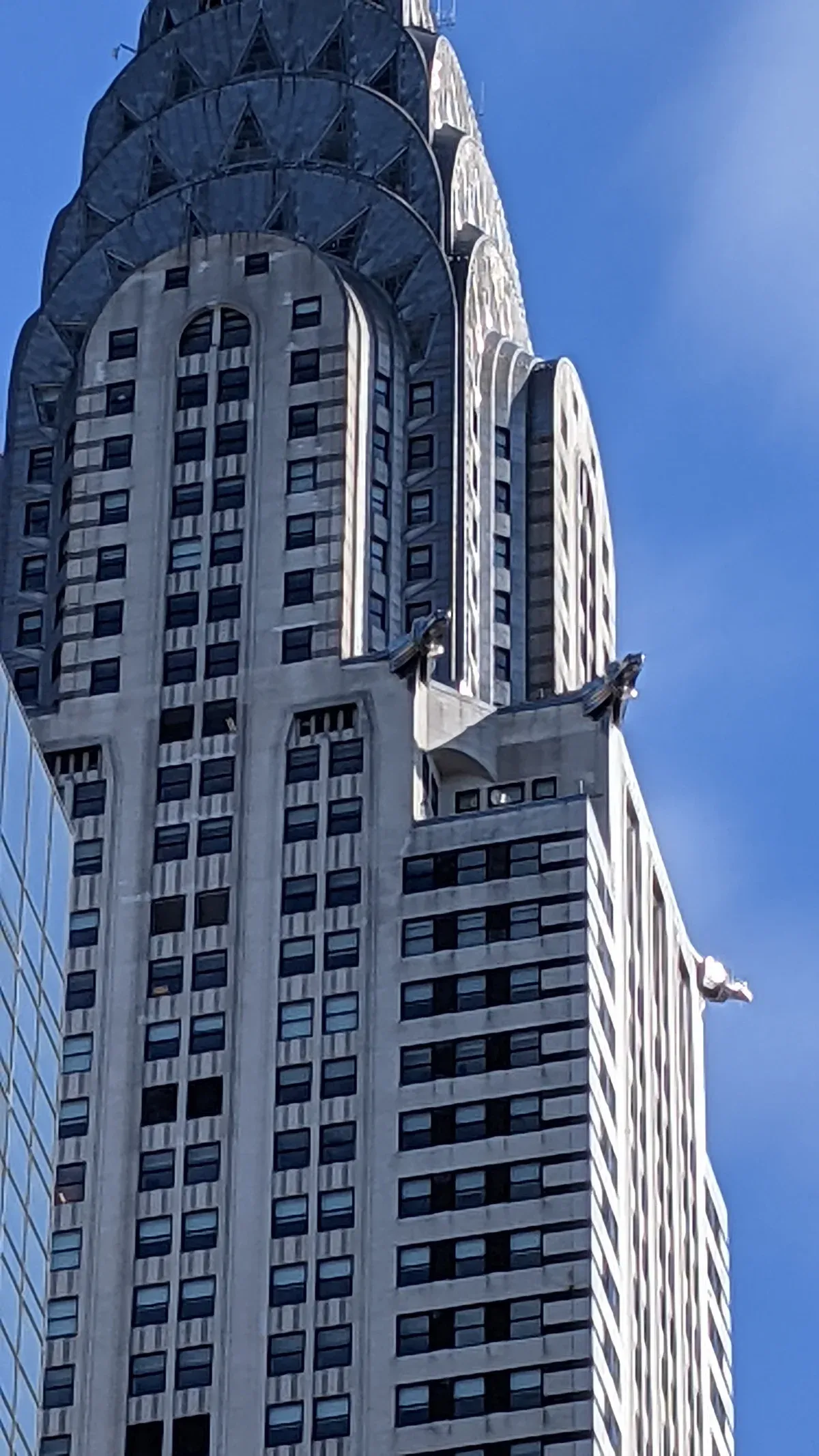
The Chrysler eagle hood ornaments on the 61st floor. Photo: PortableNYCTours, CC BY-SA 4.0, via Wikimedia Commons
Where to See It From
The tower crowns a block bounded by Lexington Avenue, 42nd Street and 43rd Street, so the best views come from the street corners around it.
Street Corners Near 405 Lexington Avenue
The address is 405 Lexington Avenue, at the corner of 42nd Street. The tower is 1,046 feet to the tip of its spire with 77 floors, and the entrance doors are finished in Nirosta steel like the spire.
For the ornaments, the corners matter more than the distance. Hood ornaments and replicas of 1929 Chrysler radiator caps sit at the 31st-floor corners, and eagle-head figures stand at the 61st floor. Margaret Bourke-White photographed those eagles from a scaffold 400 feet up in December 1929, which tells you how far off the street they really are. Bring a zoom lens or accept the silhouettes.
Viewpoints Further Out
Step back to see the crown properly. The seven radiating terraced arches of the sunburst crown are lit by tube lights framing 120 window openings, as they have been since 1981. The building has 3,862 exterior windows, and the Nirosta cladding, a stainless steel with 18 percent chromium and 8 percent nickel, was a first for an American project.
One Vanderbilt, at One Vanderbilt Avenue on the corner of 42nd Street next to Grand Central Terminal, stands 1,401 feet with its spire. For comparison, the Empire State Building is 1,454 feet to the tip of its antenna against the Chrysler Building's 1,046 feet.
Walking to It
It fits into a Midtown walk. The Art Deco and Architecture Midtown Landmarks Tour for $40 per person passes it on a route that includes Bryant Park and Rockefeller Center. If you prefer to plan your own route through Manhattan's styles, the New York City architecture tour guides list the free lobbies and self-guided options as well as the paid walks.
Tips for Visiting
Practical points for a visit to the Chrysler Building, drawn from the facts above.
Do
- Do enter the lobby from any of its three entrances on Lexington Avenue, 42nd Street and 43rd Street, because the triangular lobby opens onto all three streets.
- Do look up at the ceiling mural before anything else, because Transport and Human Endeavor by Edward Trumbull measures 110 by 67 feet and shows the Spirit of St. Louis among its planes.
- Do study the 31st-floor corners with a zoom lens, because the hood ornaments and 1929 Chrysler radiator cap replicas sit roughly 31 stories above the sidewalk and are easy to walk past unnoticed.
- Do visit in daylight and again after dark if you can, because the crown has been lit since 1981 by tube lights framing 120 window openings and reads differently at night.
- Do pair the building with Grand Central Terminal, because the original design included a staircase on the 42nd Street side running under the building to the Grand Central-42nd Street subway station.
Don't
- Don't expect to ride to a viewing platform, because the Celestial observation deck on the 71st floor operated until 1945 and a replacement deck on the 61st-story setback has only been approved on paper, in a 2020 plan.
- Don't plan your visit around published opening hours, because no official source states the lobby hours.
- Don't confuse this building with the tallest of its era, because it held the world's tallest title only from May 27, 1930 to May 1, 1931, about 11 months, before the Empire State Building opened.
- Don't credit the wrong man, because developer William H. Reynolds started the project and hired William Van Alen before Walter Chrysler bought the plot, lease and plans on October 15, 1928 for more than $2.5 million.
Chrysler Building Questions
Who bought the Chrysler Building?
Tishman Speyer was reported to have bought the building for $235 million, after the Cooper Union moved in 2024 to terminate the previous leaseholder RFR's ground lease. Ownership is changing, so treat the buyer as reported rather than final.
Who owns the land underneath the Chrysler Building?
The Cooper Union owns the land. The college received the plot in 1902, and the building's owners lease the ground rather than owning it. You can see the building itself on the Art Deco and Architecture Midtown Landmarks Tour, which passes it.
What's the difference between the Chrysler Building and the Empire State Building?
The Chrysler Building is 1,046 feet to the tip of its spire with 77 floors and opened May 27, 1930, designed by William Van Alen. The Empire State Building is 1,454 feet to the tip of its antenna with 102 stories and opened May 1, 1931. Both are Art Deco. Compare them with the rest of the skyline on an architecture tour New York City that covers Midtown.
Which is taller, the Chrysler Building or the Eiffel Tower?
The Chrysler Building. Its 125-foot spire, raised into place in 90 minutes on October 23, 1929, lifted it past the Eiffel Tower and made it the first man-made structure above 1,000 feet. The Art Deco and Architecture Midtown Landmarks Tour passes the building.
Can you go up inside the Chrysler Building?
No. The lobby is the only part described as publicly accessible, the 71st-floor Celestial deck operated until 1945, and the Cloud Club on floors 66 to 68 closed in 1979. For interiors that are actually open, the Grand Central Terminal tour takes you through a landmark you can fully enter.
Is the Chrysler Building lobby free to visit?
The lobby has been the only publicly accessible part of the building in recent decades and no source states an admission charge. The building is an NYC landmark for both facade and lobby, designated September 12, 1978, so the interior you see is protected. More free interiors are listed in the New York architecture tours guides.