 New York Architecture Tour
The Oculus NYC: Santiago Calatrava's World Trade Center Hub
The Oculus NYC is the white ribbed head house of the World Trade Center Transportation Hub, designed by Santiago Calatrava and opened on March 3, 2016. This guide looks at it as architecture: the steel ribs, the skylight, the cost (about $4 billion by one source, a $3.7 billion official budget by another), and the mall inside it. It also covers the site around the hub, from the free 9/11 Memorial pools to One World Trade Center at 1,776 feet. You will find the figures that matter, what is free and what is not, and which guided options from the comparison of New York architecture tours pass the site. The bookable tours are compared on New York City architecture tour.
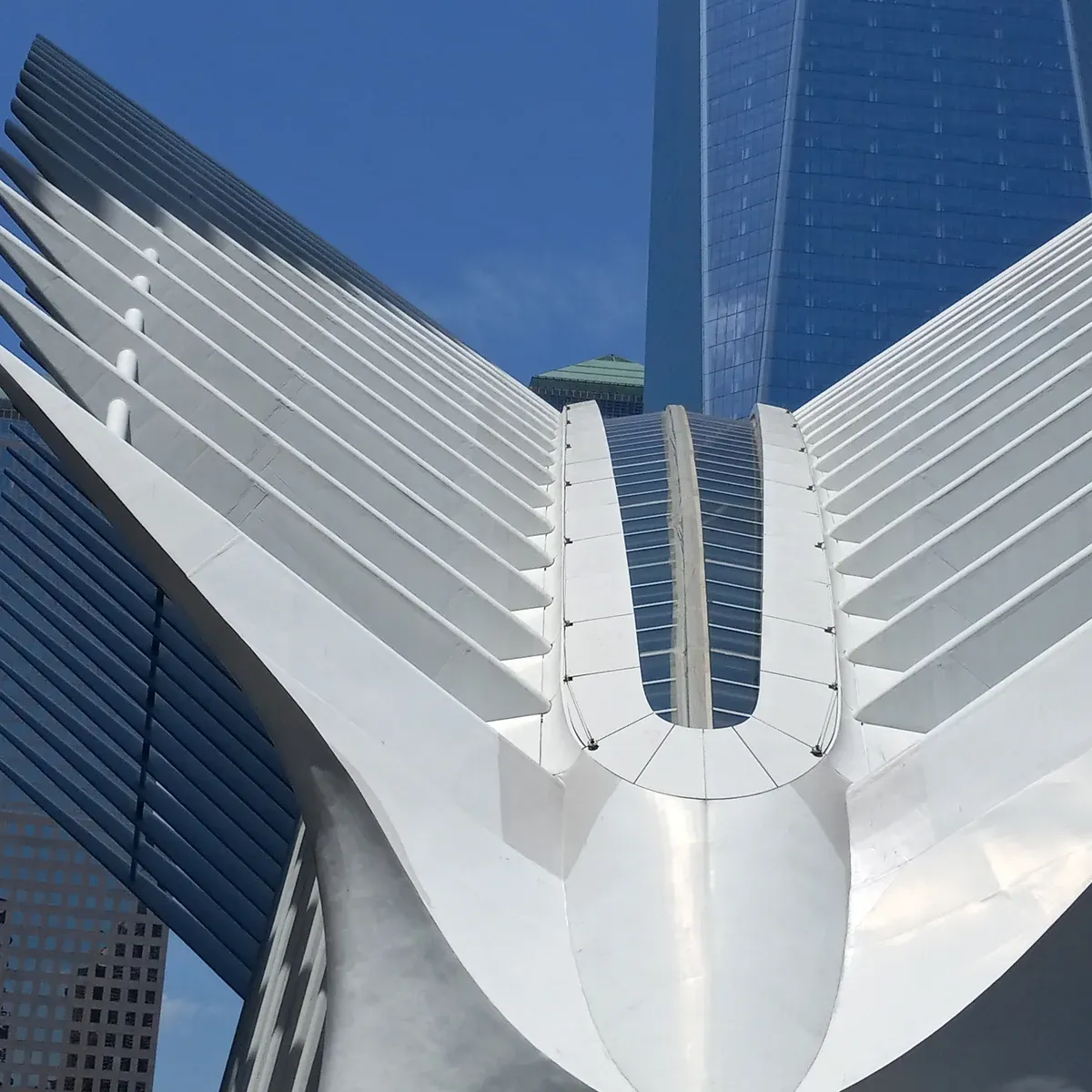
The exterior of the Oculus at the World Trade Center. Photo: Kidfly182, CC BY 4.0, via Wikimedia Commons
Quick answer The Oculus in short
The Oculus NYC is the World Trade Center PATH station house designed by Santiago Calatrava, a head house of white steel ribs that opened on March 3, 2016. Wikipedia puts the cost at approximately $4 billion, against an official budget of $3.7 billion, and critics called it the world's most expensive train station. Entry is free, and the same building holds the 365,000-square-foot Westfield World Trade Center mall.
Key takeaways
- The 9/11 Memorial pools around the Oculus are free and open daily from 8 a.m. to 8 p.m.
- One World Trade Center stands 1,776 feet with its spire, the tallest building in New York City. See the World Trade Center site section.
- The AIANY Architecture Cruise at $86 per person circles Manhattan past One World Trade Center with architects as guides.
- For the streets south of the hub, the Wall Street Insider Tour is covered on its own page, and the homepage compares every New York architecture tour by district and price.
The Oculus in Figures
The Oculus is the head house of the World Trade Center Transportation Hub, a PATH rail hub and a shopping mall in one structure. The figures below come from the sources listed at the end of the page.
Key Numbers for the Hub
The table gathers the basic facts about the Oculus: its designer, its opening, its cost, its skylight and what sits inside the building. The figures come from the sources listed at the end of the page. Anything that could not be confirmed has been left out.
One honest note on cost. Wikipedia puts the hub at approximately $4 billion, while the official budget is given elsewhere as $3.7 billion that could exceed $4 billion once Hurricane Sandy recovery costs are added. Both figures are reported here rather than averaged.
| Fact | Figure |
|---|---|
| Architect | Santiago Calatrava |
| Opened | March 3, 2016 |
| Cost | Approximately $4 billion (official budget $3.7 billion, before Sandy recovery costs) |
| Skylight span | About 330 feet |
| Mall inside | 365,000-square-foot Westfield World Trade Center |
| Mall opening | August 16, 2016, with 125 retail spaces |
| Admission | Free, publicly accessible |
| Subway links | PATH plus the 1, 2, 3, 4, 5, A, C, E, J, Z, N, R and W lines |
| Platforms | Five tracks on three island platforms and one side platform, four stories underground |
Calatrava's Design, the Ribs and the Skylight
Calatrava described his original idea as a bird being released from a child's hand. The built result is a row of white steel ribs that interlock high above the ground. The plan was scaled back for security and budget reasons, and the roof's mechanical opening was dropped in a 2008 design revision.
The skylight was built to line up with the autumn equinox sun, a gesture echoing Daniel Libeskind's 'Wedge of Light' plan for the site. The design also called for the skylight to open each September 11 for 102 minutes, marking the span from the first plane's impact to the second tower's collapse. In practice the mechanism has faltered: a broken skylight seal kept the Oculus from opening on the 2019 anniversary.
The construction story is part of the architecture. Prefabricated ribs began arriving in July 2008, and Skanska won the $542 million construction contract in summer 2010. When the hub opened in 2016, Port Authority director Pat Foye declined to hold a ceremony, calling it a 'symbol of excess', and the station opened about ten years later than first projected.
A companion piece of infrastructure opened earlier: the West Concourse, a 600-foot underpass beneath the West Side Highway linking the hub to Brookfield Place, opened on October 23, 2013 at a cost of $225 million.
If you want the hub seen from the water, the AIANY Architecture Cruise passes One World Trade Center with AIA New York Chapter architects narrating. For a building nearby, the Gothic Revival Woolworth tower gets its own page at the Woolworth Building.
The World Trade Center Site Around It
The Oculus sits at the center of the rebuilt 16-acre World Trade Center site, between the Memorial pools and the new towers. Here is what surrounds the hub.
The 9/11 Memorial: Reflecting Absence
The Memorial, called Reflecting Absence, was designed by Michael Arad of Handel Architects with landscape architect Peter Walker. It was picked in January 2004 from 5,201 entries submitted from 63 countries.
Two pools sit in the footprints of the Twin Towers. Each pool is nearly an acre in size and holds the largest man-made waterfalls in North America, a claim made by the Memorial itself, though Wikipedia limits the same claim to the United States. The names of 2,983 victims are inscribed on 152 bronze parapets: 2,977 killed on September 11, 2001 and six killed in the 1993 bombing. The names are arranged by relationships such as workplace, flight and proximity rather than alphabetically, and each panel carries an address starting with N for the North Pool or S for the South Pool.
The Memorial occupies about half of the 16-acre site and opened to the public on September 12, 2011. It is free, seven days a week, with the plaza open daily 8 a.m. to 8 p.m. at 180 Greenwich Street. The Museum is a separate ticketed visit, open Wednesday to Monday 9 a.m. to 7 p.m. plus select Tuesdays, sitting about 70 feet below ground behind a Snohetta pavilion since May 21, 2014. A free official audio guide app carries a 40-minute tour covering the events, the victims and the Memorial's design.
Look for the Survivor Tree, a Callery pear recovered from the rubble in October 2001 and replanted at the site in December 2010, when it stood 30 feet tall.
One World Trade Center
One World Trade Center was designed by David Childs of SOM and rises 1,776 feet with its spire, a figure chosen to symbolize the year of independence. The roof itself is 1,368 feet, matching the original North Tower, and the spire adds 407.9 feet. Its final spire piece was lifted on May 10, 2013.
The tower is at 285 Fulton Street, with a cornerstone laid on July 4, 2004 and an opening on November 3, 2014. It passed the Empire State Building to become the city's tallest structure on April 30, 2012. Its estimated cost reached $3.9 billion by April 2012, the most expensive building in the world at the time. The Port Authority formally renamed it from Freedom Tower in 2009, and the tower carries a 185-foot reinforced-concrete base for security.
One World Observatory opened May 29, 2015 on floors 100 to 102, at 1,268 feet. The building's numbering skips ahead: the 94th story is labeled floor 100. No official ticket price for the observatory is printed here. For context, the same tower features on the AIANY Architecture Cruise, which costs $86 per person and is narrated by members of AIA New York.
The Other Towers and the Mall
The hub partially opened on March 3, 2016 between 2 and 3 World Trade Center, with only the west end and the mall corridor to 4 World Trade Center open that day. The Westfield World Trade Center followed on August 16, 2016, filling 365,000 square feet with 125 retail spaces and run by Unibail-Rodamco-Westfield. It is the largest shopping complex in Manhattan.
Practically, the Oculus doubles as a subway station house. From the same concourse you can reach PATH trains to New Jersey and a long list of subway lines: the 1, 2, 3, 4, 5, A, C, E, J, Z, N, R and W.
The Financial District streets to the south are a story of their own. Wall Street, Trinity Church and the NYSE belong to the Wall Street Insider Tour, a 1 hour 15 minute walk at $39 per person led by former traders and bankers. To plan a full day of buildings, the homepage maps every New York City architecture tour from Midtown to Harlem.
World Trade Center Oculus Explained by Architect Santiago Calatrava
Calatrava explains his own design. Third-party video by Architectural Digest. This site did not shoot it and has no relationship with the creator.
Visiting: What Is Free
Most of what travelers come to see around the Oculus NYC costs nothing to enter. Here is what you can walk into and what needs a ticket.
The Oculus Interior
The Oculus is publicly accessible and free to enter during station hours. You walk in at street level, look up at the white steel ribs and the skylight that spans about 330 feet, and head four stories down to the PATH platforms, with five tracks on three island platforms and one side platform. The 365,000-square-foot Westfield World Trade Center mall sits inside the same structure.
On September 11 each year the skylight is designed to stay open for 102 minutes, the span from the first plane's impact to the second tower's collapse. The mechanical roof opening was dropped in a 2008 design revision, and a broken skylight seal kept it closed on the anniversary in 2019, so treat the opening as a design intention rather than a guarantee.
Getting There on PATH and the Subway
The Oculus is the head house of the PATH system to New Jersey, with the hub partially opened on March 3, 2016 between 2 and 3 World Trade Center. It also links underground to the 1, 2, 3, 4, 5, A, C, E, J, Z, N, R and W subway lines, so nearly every line through Lower Manhattan touches it.
One connected walk is free too. The West Concourse, a 600-foot underpass beneath the West Side Highway, opened October 23, 2013 and links the hub to Brookfield Place without crossing a street.
The 9/11 Memorial Pools
The 9/11 Memorial, called Reflecting Absence, is free and open to the public seven days a week from 8 a.m. to 8 p.m. It was designed by Michael Arad of Handel Architects with landscape architect Peter Walker, chosen in January 2004 from 5,201 entries in 63 countries. The two pools sit in the footprints of the Twin Towers, each nearly an acre, with what the Memorial calls the largest man-made waterfalls in North America. The names of 2,983 people are cut into 152 bronze parapets, arranged by relationships such as workplace and flight rather than alphabetically.
The Museum at 180 Greenwich Street needs an advance ticket and is open Wednesday to Monday from 9 a.m. to 7 p.m. The Memorial's official app has a free 40-minute audio tour covering the design and the victims. The Survivor Tree is a Callery pear recovered from the rubble in October 2001 and replanted at the site.
One World Trade Center From the Ground
One World Trade Center at 285 Fulton Street is the tallest building in New York City at 1,776 feet with its spire, a height that marks the year of independence. David Childs of SOM designed it, the roof sits at 1,368 feet matching the original North Tower, and the 407.9-foot spire was completed on May 10, 2013. Its One World Observatory opened May 29, 2015 on floors 100 to 102 at 1,268 feet.
The observatory's price and hours are not stated here. For the skyline view from the water instead, the Manhattan architecture cruise circles the island past the tower.
Sources: Port Authority and PATH history), 9/11 Memorial, One World Trade Center
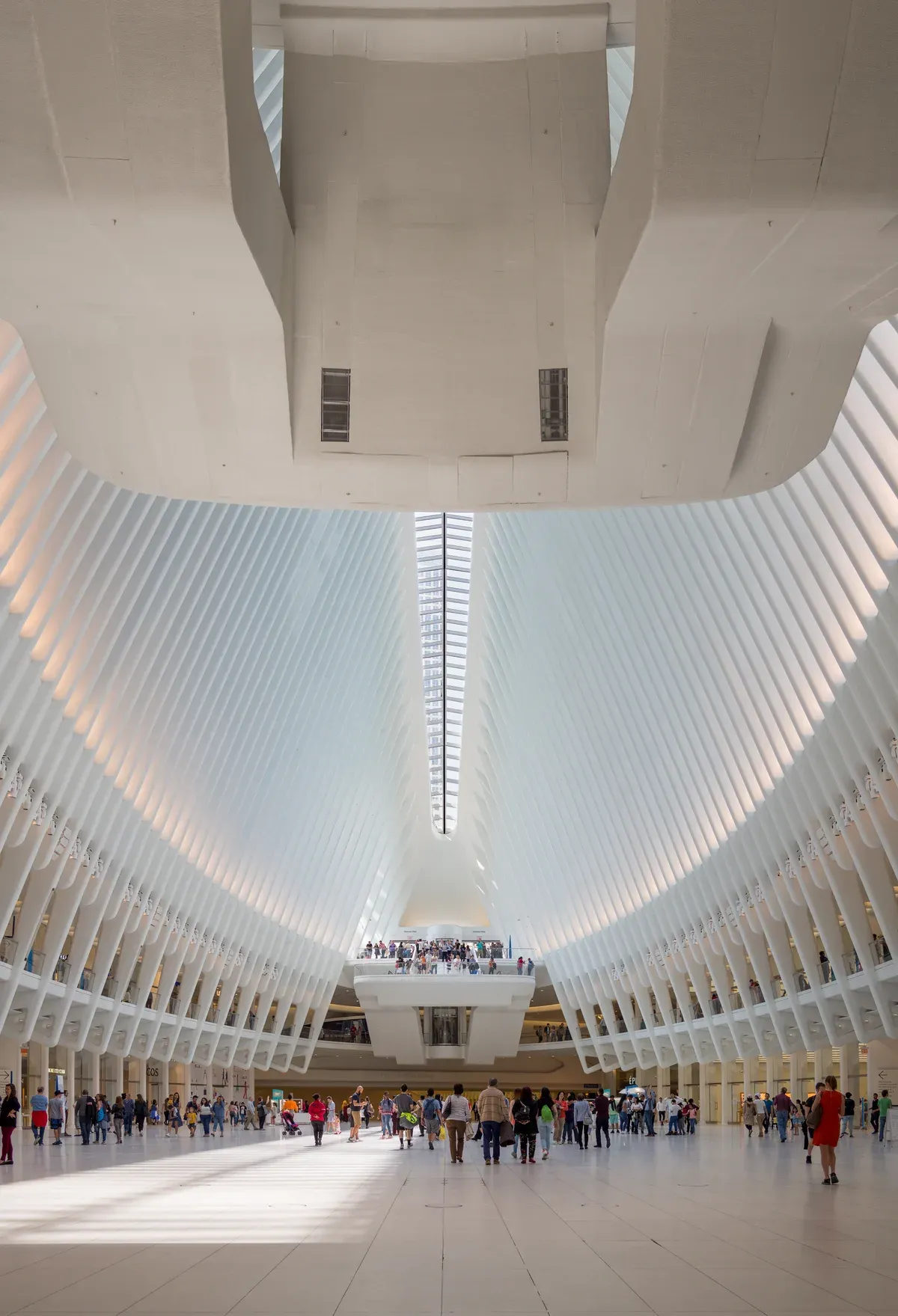
The concourse inside the Oculus at the World Trade Center station. Photo: Rhododendrites, CC BY-SA 4.0, via Wikimedia Commons
Downtown Tours That Pass It
No tour in the catalog enters the Oculus with a guide. Two downtown tours put the World Trade Center site in context, and their card prices are quoted here as listed.
The Wall Street Walk Next Door
The pick for the Financial District is the Wall Street Insider Tour at $39 per person, a 1 hour 15 minute walk led by a former trader, banker or broker. It starts outside 22 Broad Street and covers Wall Street and the Financial District, with the New York Stock Exchange entrance not included. The listing does not name the Oculus or the World Trade Center as a stop, so book it for the district's history.
Full details are on the Wall Street tour page. The Woolworth Building nearby has its own page, see the Woolworth Building guide.
Seeing the Site From the Water
The Manhattan Official NYC Architecture Cruise at $86 per person runs 2 hours to 2 hours 45 minutes from Chelsea Piers, Pier 62, and passes One World Trade Center from the harbor along with 8 Spruce Street, the Woolworth Building and the Wall Street Art Deco spires. The guides are architects and members of the AIA New York Chapter, and one drink is included. It names One World Trade Center, not the Oculus itself, so the ribs and the interior are not covered.
Compare the options below before you book.
Both are listed on the same comparison table of New York architecture tours along with the rest of the catalog.
| Tour | Price | Duration | Guide | What it passes |
|---|---|---|---|---|
| Wall Street Insider Tour | $39 per person | 1 hour 15 minutes | Former trader, banker or broker | Wall Street and the Financial District |
| Manhattan Official NYC Architecture Cruise | $86 per person | 2 hours to 2 hours 45 minutes | AIA New York architects | One World Trade Center from the harbor |
Tips for the Oculus and WTC
Do
- Do enter the Oculus from street level with no ticket, because it is publicly accessible and free to enter as the PATH station house.
- Do plan the Memorial plaza between 8 a.m. and 8 p.m., because that is when it is open daily, and the 9/11 Memorial is free seven days a week.
- Do download the Memorial's official audio guide app before you arrive, because its 40-minute tour covers the victims, the events of 9/11 and the design of Reflecting Absence.
- Do look for the Survivor Tree at the site, a Callery pear recovered from the rubble in October 2001 and replanted at the site when it stood 30 feet tall.
- Do buy a Museum ticket in advance, because the Museum requires an advance ticket while the outdoor Memorial does not.
Don't
- Don't count on seeing the skylight open on September 11, because the mechanical roof opening was dropped in a 2008 design revision and a broken seal kept it shut in 2019.
- Don't expect the hub to be an observation deck, because its floors are a transit hall and the 365,000-square-foot Westfield mall, not a viewing platform.
- Don't be thrown by the floor numbers, because One World Observatory occupies floors 100 to 102 while the 94th story is labeled floor 100 in the building's numbering.
- Don't call the hub a finished vision of the first design, because Calatrava's bird-released-from-a-child's-hand plan was scaled back for security and budget reasons and opened about ten years later than first projected.
FAQ
Who designed the Oculus in NYC?
The architect is Santiago Calatrava, who designed the white steel ribs of the World Trade Center Transportation Hub and described the original concept as a bird being released from a child's hand. The plan was scaled back for security and budget reasons. The full history is above.
What is the Oculus at WTC?
It is the head house of the World Trade Center Transportation Hub, a PATH station house linking New Jersey trains to the 1, 2, 3, 4, 5, A, C, E, J, Z, N, R and W subway lines, with the 365,000-square-foot Westfield World Trade Center mall inside. It opened March 3, 2016. More background is above.
How tall were the 9/11 Towers compared to One World Trade Center?
One World Trade Center matches the original North Tower's roof at 1,368 feet and tops it with a 407.9-foot spire, bringing it to 1,776 feet. It passed the Empire State Building as the city's tallest structure on April 30, 2012.
What happened to the underground mall after 9/11?
Westfield World Trade Center opened August 16, 2016 inside the new hub as Manhattan's largest shopping complex with 125 retail spaces. The Oculus is free to enter, so you can walk through it on any visit.
Is the Oculus free to visit in New York?
Yes, the Oculus is publicly accessible and free to enter, and the 9/11 Memorial plaza is also free daily from 8 a.m. to 8 p.m. Only the Museum and the observatories need tickets. The nearby financial district is best read about on the Wall Street Insider Tour page.
Which tours cover the World Trade Center site?
No catalog tour enters the Oculus. The Manhattan Official NYC Architecture Cruise passes One World Trade Center from the harbor with AIA New York architects narrating, and the Wall Street walk covers the Financial District to the south. Both appear in the comparison of New York City architecture tour options.