 New York Architecture Tour
The Flatiron Building: New York's Triangular Landmark
The Flatiron Building is the wedge of terracotta at 175 Fifth Avenue where Broadway cuts across the Manhattan grid. This guide covers the architects, the 1902 completion, the triangular plot that gave the tower its name and the conversion now turning the offices into private homes. It also answers whether you can go inside the Flatiron Building, which no official source says is open to the public, and explains where to stand for the photo, what to see in Madison Square Park next door and how the tower fits into a wider New York architecture tour. The bookable tours are compared on New York City architecture tour.
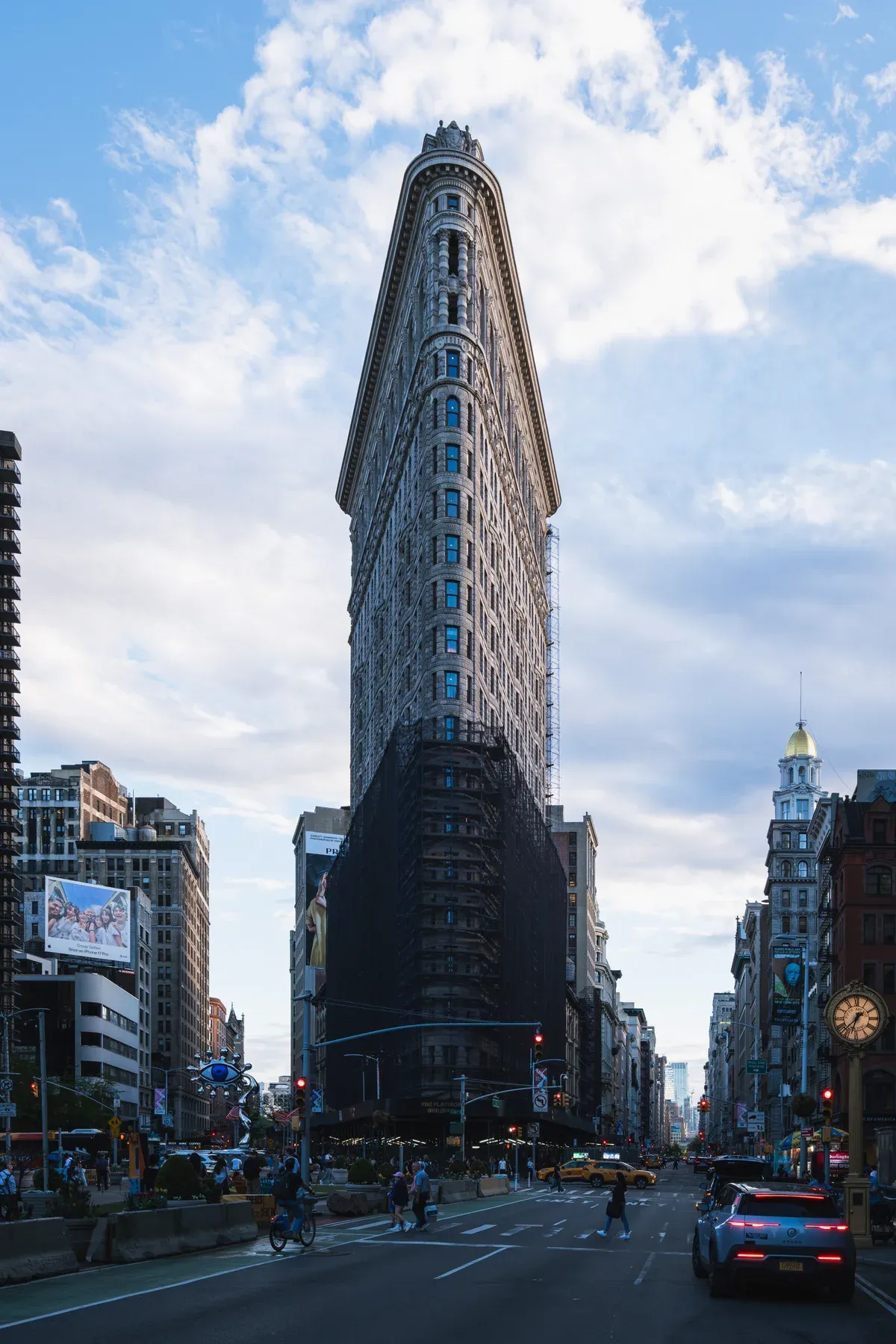
The Flatiron Building (Daniel Burnham, 1902) at the junction of Fifth Avenue and Broadway. Photo: Christian David, CC BY-SA 4.0, via Wikimedia Commons
Quick answer The Flatiron Building at a glance
The Flatiron Building is a 307-foot, 22-story triangular skyscraper at 175 Fifth Avenue, completed in 1902 and now being converted into private condominiums. No source describes any public access to the lobby or interior, and the building is becoming private homes, so treat it as an exterior sight. The best views come from the sidewalk at Fifth Avenue and East 23rd Street and from Madison Square Park.
Key takeaways
- Get the key numbers in The Flatiron Building in Figures, from the 1902 completion to the 307-foot height.
- No catalog tour stops here, so most visitors pair the tower with the Art Deco Midtown Walk or the AIANY Architecture Cruise for a guided take on Manhattan's skyline.
- Trace the story from offices to homes in From Fuller Building to Residences.
- Compare it with the city's other landmarks on the guide to famous buildings in NYC, and browse all New York architecture tours for the full list.
The Flatiron Building in Figures
Before you go, here are the essentials. The table pulls the core figures from the standard reference record on the building, so you can plan the visit and know what you are looking at.
Key Facts
The Flatiron Building sits on a sliver of land where Fifth Avenue and Broadway cross at 23rd Street, and almost everything distinctive about it follows from that plot. The figures below cover the architect, the completion, the size and the protections now on the building. Note the height with care: the tower originally stood 285 feet over 20 stories, and an attic and penthouse added later brought it to today's 307 feet and 22 stories.
| Fact | Figure |
|---|---|
| Architects | Daniel Burnham and Frederick P. Dinkelberg of D. H. Burnham & Co. |
| Completed | June 1902, opened October 1, 1902 |
| Address | 175 Fifth Avenue |
| Height and stories | 307 feet, 22 stories |
| Style and facade | Renaissance Revival with Beaux-Arts elements, glazed terracotta by the Atlantic Terra Cotta Company |
| Landmark status | NYC landmark 1966, National Historic Landmark 1989, National Register 1979 |
Why Is the Flatiron Building Triangular?
Because the plot is. The block between Fifth Avenue and Broadway narrows to a point as the two avenues converge, and East 22nd Street closes the triangle, with East 23rd Street grazing the northern peak. The site measures 197.5 feet along Fifth Avenue, 214.5 feet along Broadway and 86 feet along 22nd Street.
It is a scalene right triangle, not the even-sided shape of a real flatiron, and at the prow the tower is only about 6 feet wide. The name came from the street, not the architects: the site was already known as Eno's flatiron before construction began, because the shape recalls a cast-iron clothes iron. Locals doubted a building this narrow could stand and called the project Burnham's Folly.
The engineers answered that. The steel frame of about 3,680 short tons came from the American Bridge Company, with Purdy and Henderson as structural engineers, and it was designed to withstand four times the area's maximum wind force. The foundation reaches bedrock about 35 feet below street level.
Sources: Wikipedia
From Fuller Building to Residences
The tower has spent more than a century as offices and is now turning into homes. Here is that story, and what it means for visitors.
Built for the Fuller Company
The building went up as the headquarters of the Fuller Company, a construction firm. Its chief executive, Harry S. Black, bought the site from the Newhouse family in May 1901. In August 1902 the company announced that the tower would officially be named for its founder, George A. Fuller.
New Yorkers ignored the official label and kept calling it the Flatiron, and the nickname won. Today the Fuller name survives on a later tower of the same company, the Fuller Building on Madison Avenue of 1929, whose own lobby mosaics depict the Flatiron among the firm's projects. The original name matters for visitors for one reason: if you search old guidebooks for the Fuller Building at Fifth Avenue and 23rd Street, they mean this tower.
A Century of Offices
The Flatiron Building opened on October 1, 1902 and worked as an office building. It was one of the first two skyscrapers protected as NYC landmarks, together with the Municipal Building, in 1966, and it joined the National Register of Historic Places in 1979. It also sits inside the Ladies' Mile Historic District, which stretches from 15th Street to 24th Street.
Small details survive from the working years, including the wooden revolving doors at the 22nd Street corners, installed in 1910. The publisher Macmillan occupied the building for decades and left by June 2019, which left all 21 office floors vacant ahead of renovation.
The Conversion to Condominiums
A New York court ordered the building auctioned, and an ownership group of Jeffrey Gural, Newmark, Sorgente Group and ABS Partners took full control with a $161 million bid. The Brodsky Organization later bought a controlling stake and announced a conversion to residential condominiums with interiors by Studio Sofield. The reference record describes the scheme as 38 units in one passage and 36 apartments in another, so treat the count as between those two figures.
What is clear is the direction of travel. The scaffolding has come off the exterior, fourteen of thirty-six apartments were reported sold in the most recent count, and the restaurateurs Jody Williams and Rita Sodi were hired to open Bar Pisellino Flatiron in the building. The Landmarks Preservation Commission also approved permanent nighttime lighting of the facade, a first for the building.
Can You Go Inside the Flatiron Building?
No. No source describes any public access to the lobby or interior, and the building is being converted to private condominiums, so plan on the exterior only. There is no observation deck, no lobby tour and no ticket to buy, which sets the tower apart from buildings like Grand Central or the Woolworth Building downtown, where guided lobby visits do exist. That is also why no tour in the catalog names the Flatiron as a stop.
If you want a guide's narration nearby, the closest bookable option is the Art Deco and Architecture Midtown Landmarks Tour at $40 per person, which passes the Library, the Chrysler Building and Rockefeller Center, or the architect-narrated cruise around Manhattan for the skyline from the water. For a self-guided day, plot the tower on the map of famous buildings in NYC and combine it with the sights around Madison Square.
Sources: Wikipedia
The Flatiron: The Story of New York's Strangest Tower
How the triangular tower came about and what happened to it since. Third-party video by The B1M. This site did not shoot it and has no relationship with the creator.
Visiting the Flatiron District
The Flatiron Building sits at the crossing of Fifth Avenue and Broadway, and the district around it rewards a slow walk. This part covers the park, the subway and the streets worth pairing with the tower at 175 Fifth Avenue.
Madison Square Park
Madison Square Park is a 6.2-acre park at 23rd Street, where Fifth Avenue and Broadway cross at the northern end of the Flatiron District. It opened to the public on May 10, 1847, so it predates the tower by more than half a century. The park's edge gives you the classic angle on the 307-foot facade.
Buildings around the square include the Flatiron Building, the Toy Center, the New York Life Building, the Appellate Division Courthouse and the Met Life Tower, so one lap of the park covers several eras of New York architecture. For more stops like this, the map of famous buildings in NYC lays out the whole set on one page.
Getting There
The nearest subway is 23rd Street on the R and W lines, which is the nearest subway to the building. The plot itself is a scalene right triangle formed by Fifth Avenue, Broadway and East 22nd Street, with East 23rd Street grazing the northern peak. If you are planning a full day of sightseeing, the guide to New York architecture tours sorts the city by district and style and helps you combine a Flatiron visit with a longer route.
Nearby Buildings Worth Pairing
The Flatiron sits inside the Ladies' Mile Historic District, which stretches from 15th Street to 24th Street, so the walk north or south runs through a protected historic district. Two nearby towers make good comparisons. The Fuller Building on Madison Avenue was designed by Walker & Gillette and completed on September 7, 1929, and its lobby has floor mosaics of the Tacoma, Flatiron and Fuller buildings.
The American Radiator Building at 40 West 40th Street, completed in 1924 and 338 feet tall, wears black brick with gold-colored ornament and became an NYC landmark in November 1974. The table below compares the three stops on foot.
| Building | Address | Year | Height |
|---|---|---|---|
| Flatiron Building | 175 Fifth Avenue | 1902 | 307 feet, 22 stories |
| Fuller Building | Madison Avenue | 1929 | not stated |
| American Radiator Building | 40 West 40th Street | 1924 | 338 feet |
Can You Go Inside
No source states that the Flatiron Building interior or lobby is open to the public. The building is being converted to private condominiums, so plan on the exterior only. The conversion is real and visible: Macmillan left by June 2019, leaving all 21 office floors vacant, and an ownership group bought full control with a $161 million bid after a court-ordered auction.
Daniel Brodsky's Brodsky Organization took a controlling stake and announced residential condominiums with interiors by Studio Sofield. Scaffolding came off the exterior in early 2026, and by August fourteen of thirty-six apartments had been sold. In 2026 the restaurateurs Jody Williams and Rita Sodi were hired to open Bar Pisellino Flatiron in the building, which may one day give visitors a reason to step through the door.
Until anything official confirms public access, treat the lobby as closed.
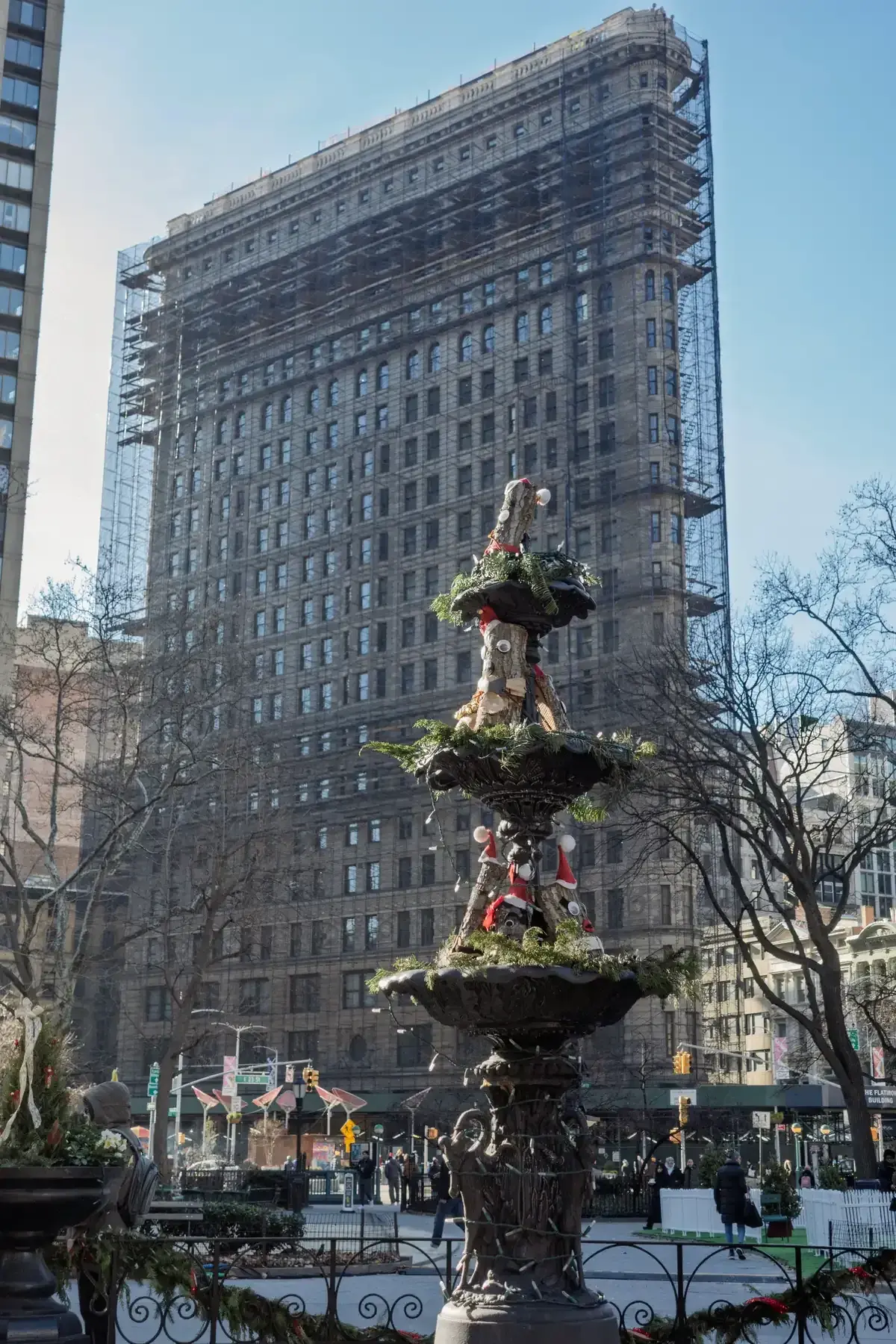
The Madison Square Fountain with the Flatiron Building behind it. Photo: Ethan Long, CC BY-SA 4.0, via Wikimedia Commons
Tours and the Flatiron
An honest note before you book: none of the walking tours in the comparison catalog names the Flatiron Building as a stop. Here is what the closest options actually cover.
No Catalog Tour Stops Here
None of the listings on the site names the Flatiron Building on its route. The guided tours cluster in Midtown, downtown and the villages, and the Flatiron District sits between their territories. That is not a reason to skip the building, since the best viewing is free from the public sidewalk and the park.
Use the comparison table of New York architecture tours to see prices, durations and routes side by side, and treat the Flatiron as a stop you add on your own.
The Closest Bookable Walk
The pick for architectural context near this neighborhood is the Art Deco and Architecture Midtown Landmarks Tour by Custom NYC Tours, at $40 per person. It runs 2 hours 30 minutes, is capped at 10 guests and covers Bryant Park, the New York Public Library, the American Radiator Building, the Chanin and Chrysler Buildings, Grand Central Terminal and Rockefeller Center. It does not pass the Flatiron Building, so plan a separate trip south on the R or W line afterwards.
If your interest is the era that shaped New York's towers, the page on the Art Deco Midtown walk has the full route and booking details.
Seeing the Flatiron on Your Own
The practical plan is simple. Take the R or W to 23rd Street, walk to Madison Square Park, and circle the block formed by Fifth Avenue, Broadway and East 22nd Street. The exterior is best read from the park side, where the full 22-story elevation and the glazed terracotta by the Atlantic Terra Cotta Company are visible without crossing traffic.
Pair the visit with the famous buildings in NYC map, which places the Flatiron among 36 profiled buildings and gives you a self-guided route between them. The Landmarks Preservation Commission has approved permanent nighttime lighting of the facade, a first for the building, so an evening pass may now show the terracotta in a new light.
Do and Don't
Five things to do and four to avoid, each with the reason, all drawn from the documented facts about the building and its block.
Do
- Do use the 23rd Street station on the R and W lines, because it is the nearest subway to the building.
- Do allow time for Madison Square Park, because its 6.2 acres at the Fifth Avenue and Broadway crossing give a full-width view of the 307-foot tower.
- Do look up at the narrow end, because the prow is only about 6 feet wide and the taper is the feature that makes the silhouette.
- Do note the original name, because the tower opened as the Fuller Building in 1902 and New Yorkers kept calling it the Flatiron after the shape of a cast-iron clothes iron.
- Do visit after dark if you can, because permanent nighttime lighting of the facade was approved by the Landmarks Preservation Commission, a first for the building.
Don't
- Don't plan to go inside, because no source states the interior or lobby is open to the public and the building is being converted to private condominiums.
- Don't expect a bookable guided tour of the building, because none of the listed walking tours names the Flatiron as a stop.
- Don't judge the structure by the early skeptics, because locals called it Burnham's Folly, yet the steel frame of about 3,680 short tons was designed to withstand four times the area's maximum wind force.
- Don't try to find an observation deck, because the Flatiron has none documented and the building opened in 1902 as offices for the Fuller Company, not as a tourist attraction.
Flatiron Building Questions
What is the Flatiron Building used for now?
It is being converted from offices into private residential condominiums, with completion targeted for 2026 per Wikipedia. Scaffolding came off the exterior in early 2026 and fourteen of thirty-six apartments had been sold by August. Bar Pisellino Flatiron is planned for the building. See the Flatiron Building guide for the full story.
Can you go inside the Flatiron Building?
No source states that the interior or lobby is open to the public, and the building is becoming private condominiums, so plan on the exterior only. Madison Square Park across 23rd Street is the best free viewpoint. The route ideas on the famous buildings in NYC map pair it with nearby stops.
Is there a guided tour of the Flatiron Building?
No tour in the catalog names the Flatiron as a stop. The closest bookable architecture walk is the Art Deco and Architecture Midtown Landmarks Tour at $40 per person, which covers Midtown landmarks 2 hours 30 minutes but stays north of the Flatiron District.
Why is it called the Flatiron Building?
The triangular shape recalls a cast-iron clothes iron, and the site was already called Eno's flatiron before construction. The official name announced in August 1902 was the Fuller Building for company founder George A. Fuller, but New Yorkers kept saying Flatiron and the nickname won. Details are in the Flatiron Building history above.
What movies has the Flatiron Building been in?
No film appearances are documented on this page, so that list is left to film databases rather than guessed. What is documented is the building's design pedigree, from Daniel Burnham and Frederick P. Dinkelberg to the 1966 NYC landmark designation. Browse famous buildings in NYC for other screen-familiar towers.
What subway stop is closest to the Flatiron Building?
23rd Street on the R and W lines is the nearest subway to the building at 175 Fifth Avenue. The site is bounded by Fifth Avenue, Broadway and East 22nd Street, with East 23rd Street grazing the northern peak.